
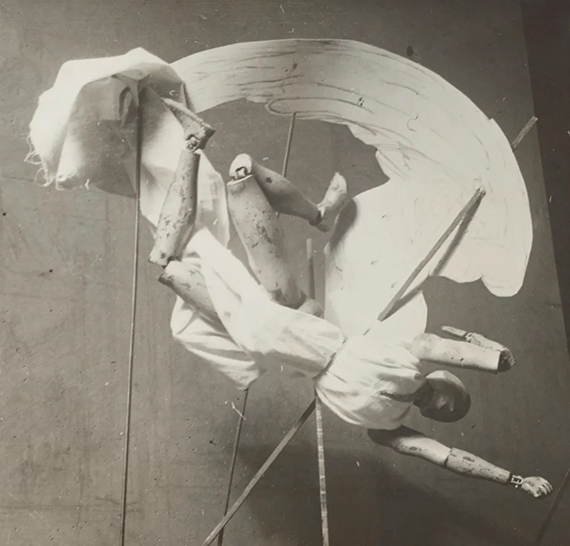
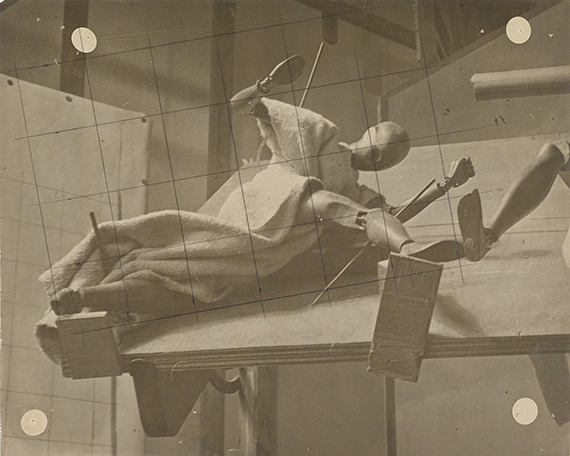
Étude pour la Cathédrale de Vich,
after 1938
Vintage gelatin silver print
24 x 30 cm
José María Sert »
Études photographiques
Exhibition: 30 May – 31 Jul 2026
Sun 28 Jun

Galerie Julian Sander
Bonner Str. 82
50677 Köln
+49 (0)221-170 50 70
galerie@galeriejuliansander.de
www.galeriejuliansander.de
Wed-Fri 10-18, Sat 12-16 + b.a.
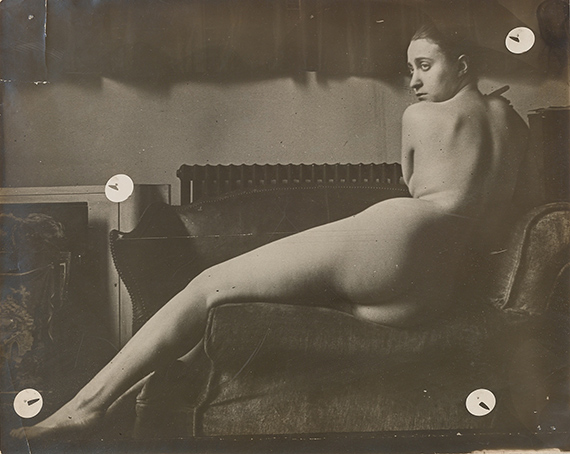
Étude pour l’Hommage à la Maison d’Albe, Chapelle du Palais de Liria, Madrid, c. 1931/32
Vintage gelatin silver print
23.8 x 29.8 cm
José María Sert
"Études photographiques"
Exhibition: May 30 – July 31, 2026
Opening: Friday, May 29, 6–9 p.m.
With an introduction by Anne Ganteführer-Trier
The Spanish decorative painter José María Sert (1874–1945), was one of the most dazzling and highest-paid artists of his time, in the first half of the 20th century. His imaginative and opulent designs for luxurious private villas and public buildings, inspired by Italian Cinquecento art, made him a favorite of the Parisian and New York haute volée. Trained artistically in his father’s business—a tapestry manufacturer—he moved to the French capital in his mid-twenties and set up a studio there. Sert married Misia Godebska, muse and model to numerous renowned artists, and maintained close relationships with writers such as Guillaume Apollinaire, Marcel Proust, Paul Valéry, Colette, and Paul Claudel. His connections to famous figures and the aristocracy brought him lucrative commissions. Among his best-known works are the decoration of the Cathedral of Vic in Catalonia and the Palais des Nations in Geneva (now the European headquarters of the United Nations), as well as paintings for the Rockefeller Center and the Waldorf Astoria Hotel in New York.
It was not until the mid-1980s that his photographic oeuvre was discovered, revealing that the artist made extensive use of the camera in the conception of his murals: with the aid of various props and stage-like constructions, he staged his models—including female and male nudes—in his studio, photographed them, and transferred the images into his paintings. Stuffed animals, model ships, and seashells, arranged into highly idiosyncratic still lifes, expanded his range of motifs. From the late 1920s onward, he preferred to work with articulated dolls, which, viewed through the lens of his camera and situated somewhere between the dramatic poses of Mannerism and the lifeless-yet-vivid figurines of Surrealism, develop a strange life of their own. It is in this, as well as in the peculiar confrontation of centuries-old subjects with the modernity of his photographic approach, that the appeal of Sert’s photographs lies.
Furthermore, the vintage prints from the Gerd Sanders estate captivate with their charming, object-like quality. Partly retouched by hand and supplemented with details, marked with grid lines for true-to-scale transfer into painting, and bearing the occasional trace of the studio, they do not deny their original function as the artist’s working material. These unique prints were exhibited at the Georg Kolbe Museum in Berlin in 1996 and are now being presented again for the first time.
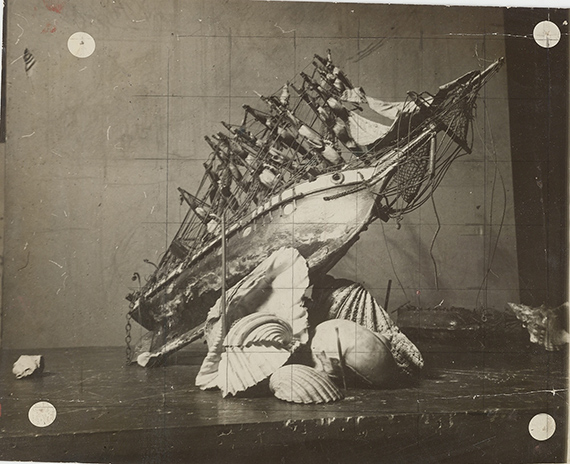
Étude pour "Sindbad le Marin", Résidence de Joshua S. Gosdem, Palm Beach, Florida, c. 1923
Vintage gelatin silver print and pencil
23.8 x 29.9 cm
José María Sert
"Études photographiques"
Ausstellung: 30. Mai bis 31. Juli 2026
Eröffnung: Freitag, 29. Mai, 18-21 Uhr
Mit einer Einführung von Anne Ganteführer-Trier
Der heute weitgehend in Vergessenheit geratene spanische Dekorationsmaler José María Sert (1874 – 1945) zählte in der ersten Hälfte des 20. Jahrhunderts zu den schillerndsten und bestbezahlten Künstlerfiguren seiner Zeit. Seine phantasievoll-opulenten, an der italienischen Kunst des Cinquecento orientierten Ausgestaltungen luxuriöser Privatvillen und öffentlicher Gebäude machten ihn zu einem Liebling der Pariser und New Yorker Haute Volée. Künstlerisch ausgebildet im Betrieb seines Vaters, einem Gobelinfabrikanten, zog er mit Mitte zwanzig in die französische Hauptstadt und richtete sich dort ein Atelier ein. Sert heiratete Misia Godebska, Muse und Modell zahlreicher namhafter Künstler, und pflegte enge Beziehungen zu Schriftstellern wie Guillaume Apollinaire, Marcel Proust, Paul Valéry, Colette und Paul Claudel. Seine Kontakte zu berühmten Persönlichkeiten und zur Aristokratie brachten ihm lukrative Aufträge ein. Zu seinen bekanntesten Arbeiten zählen die Ausgestaltung der Kathedrale von Vic in Katalonien und des Palais des Nations in Genf (heute europäischer Sitz der Vereinten Nationen) sowie Gemälde für das Rockefeller Center und das Waldorf Astoria Hotel in New York.
Erst Mitte der 1980er-Jahre wurde sein fotografisches Œuvre entdeckt und damit offenbar, dass sich der Künstler bei der Konzeption seiner Wandgemälde intensiv der Kamera bediente: Unter Zuhilfenahme verschiedener Requisiten und bühnenartiger Konstruktionen inszenierte er seine Modelle – darunter weibliche und männliche Akte - in seinem Atelier, lichtete sie ab und übertrug die Aufnahmen in seine Malerei. Ausgestopfte Tiere, Schiffsmodelle und Muscheln, arrangiert zu höchst eigenwilligen Stillleben, erweiterten seine Motivwelt. Seit Ende der 1920er-Jahre arbeitete er bevorzugt mit Gliederpuppen, die, betrachtet durch das Objektiv seiner Kamera und angesiedelt irgendwo zwischen den dramatischen Posen des Manierismus und den leblos-lebendigen Figurinen des Surrealismus, ein merkwürdiges Eigenleben entwickeln. Darin wie auch in der eigentümlichen Konfrontation der jahrhundertealten Sujets mit der Modernität seines fotografischen Zugriffs liegt der Reiz der Aufnahmen Serts.
Darüber hinaus bestechen die aus dem Nachlass Gerd Sanders stammenden Vintage Prints durch ihren charmanten Objektcharakter. Teils von Hand überarbeitet und um Details ergänzt, mit Quadratnetzen zur maßstabsgetreuen Übertragung in die Malerei versehen und die eine oder andere Atelierspur aufweisend, verleugnen sie nicht ihre ursprüngliche Funktion als Arbeitsmaterial des Künstlers. Die unikaten Abzüge waren 1996 im Georg Kolbe Museum in Berlin ausgestellt und werden nun erstmals wieder präsentiert.
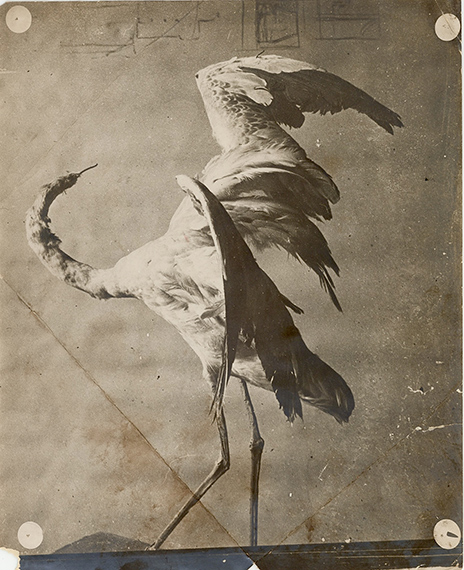
Étude pour la Cathédrale de Vich,
after 1918
Vintage gelatin silver print
29.6 x 23.9 cm
Étude pour le grand vestibule du Rockefeller Center, New York, c. 1931
Vintage gelatin silver print and pencil
24 x 30 cm