

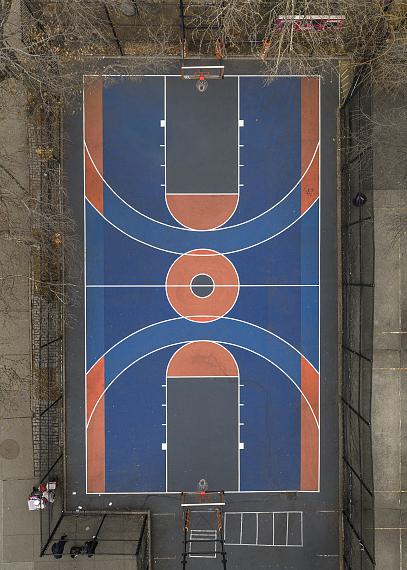
Queens, NY, 2026
Archival pigment print on forex
162.6 x 116 cm (179 x 130 cm)
Unique
Sean Hemmerle »
HOOPS
Exhibition: 21 Feb – 18 Apr 2026

Galerie Julian Sander
Bonner Str. 82
50677 Köln
+49 (0)221-170 50 70
galerie@galeriejuliansander.de
www.galeriejuliansander.de
Wed-Fri 10-18, Sat 12-16 + b.a.
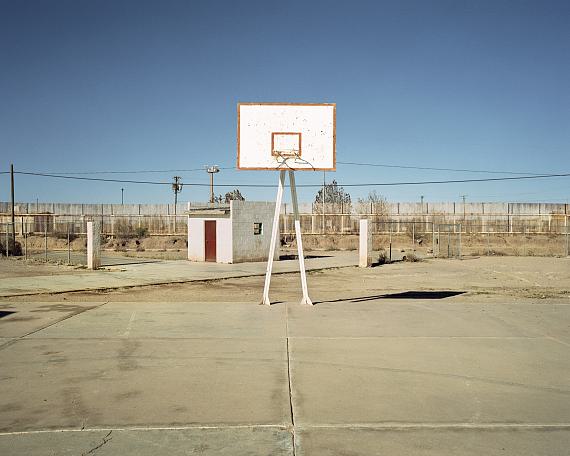
Nogales, Sonora, Mexico, 2008
Archival pigment print
43.2 x 52.5 cm
Edition of 5
Sean Hemmerle
"HOOPS"
Exhibition: 21 February – 18 April 2026
Opening: Freitag, 20. Februar, 6-9 pm
The artist is present.
For over twenty years, American photographer Sean Hemmerle (born 1966) has been exploring the
theme of basketball as an international cultural phenomenon that transcends borders, languages,
and religions in his series Hoops.
The first image in the series was taken in 2003. At the time, Hemmerle was documenting crisis areas and had therefore traveled to Iraq. When he saw a basketball court in Baghdad, it occurred to him that, against the backdrop of the controversial
actions of the Bush administration, this sport might be the most significant cultural export of the
United States. Since then, Hemmerle has documented basketball courts across the North American
continent, from Arizona to New Hampshire, from Texas to Canada, as well as fourteen other
countries in Europe, Asia, Latin America, and Africa to capture what he sees as a symbol of "a better
form of American diplomacy" with the hoops, as they are able to represent the true diversity and
spirit of his homeland much more appropriately in the world than any other export goods. It is not
the law of the strongest, but a high degree of team spirit and the integration of each individual
player into the team that characterizes this sport, which was invented in 1891 by a Canadian in
Springfield, Massachusetts, and became one of the most widespread team sports worldwide during
the 20th century.
The eponymous protagonist of the series—the simple yet iconic construction consisting of
a stand, backboard, and basket—is photographed in frontal view by Hemmerle and placed in the
center of the image. However, it is the surrounding space that takes on equal significance in his
images, i.e., the landscape or urban structure in which the hoop is located. The viewer instinctively
begins to search the surrounding area—Hemmerle photographs exclusively publicly accessible open
spaces—for clues that allow local identification. Characters as well as the country's typical
architecture, landscape, and vegetation serve as clues here.
The consistently identical, universal
construction principle of the hoop, whether photographed in Hebron or Reykjavik, Cologne or the
Bronx, as well as Hemmerle's uniform, strictly objective mode of photography, invite comparative
viewing. This is further enhanced by the hanging of the pictures in the form of a tableau. The
tradition in which Hemmerle's work stands is unmistakably visible here. The photographs of Bernd
and Hilla Becher, in which the industrial architecture captured becomes an "anonymous sculpture,"
are just as relevant here as the New Topographics, which traced the interventions in the landscape
altered by humans in their images.
In 2025, Sean Hemmerle began expanding the series with aerial photographs of basketball
courts, which he takes using a drone. From above, he transforms the courts, with their numerous
playing field lines contrasting brightly against different colored backgrounds, into aesthetically
appealing, graphically abstract structures that—due to weathering or cleaning marks, for
example—sometimes have a painterly effect. Like the Hoops photographed from the front, most
of the Courts are deserted, with a few exceptions, yet artifacts in the images of both series of
works bear witness to those who use the courts: trash left at the edge of the playing field, discarded clothing, tags and graffiti, or tire marks from motorcycles, which contrast with the bright markings
on the playing field in the form of circular, dark structures. These narrative elements and visual
references to a "before" give the images a temporal dimension, making them building blocks of
narrative that, upon closer inspection, is expanded by further details such as chipped paint,
crumbling asphalt, cracks, leaves, and puddles.
In the Courts series, which have so far been photographed exclusively in the USA, the motif
and the material used by Sean Hemmerle—for several years now, he has preferred to print his
digitally photographed images on high-quality Hahnemühle paper—form a successful combination:
the slightly textured, velvety surface of the paper provides a haptic counterpart to the court
surfaces.
Hemmerle's images celebrate the hoop as a universal icon, a symbol that stands for
solidarity, togetherness, and fair play, and which asserts itself worldwide, regardless of geopolitical upheavals, resistances, and crises. In today's times of ongoing unrest and conflict, and against the backdrop of recent events in the USA, the relevance of his artistic approach is evident.
Sean Hemmerle's photographs have been exhibited internationally, his works are included
in private collections (Elton John, Martin Margulies) and and institutions such as the Museum of
Modern Art, New York, the International Center of Photography, New York and the Museum of
Fine Arts, Houston. His photographs have been published in major publications, including Time and
The New York Times Magazine.
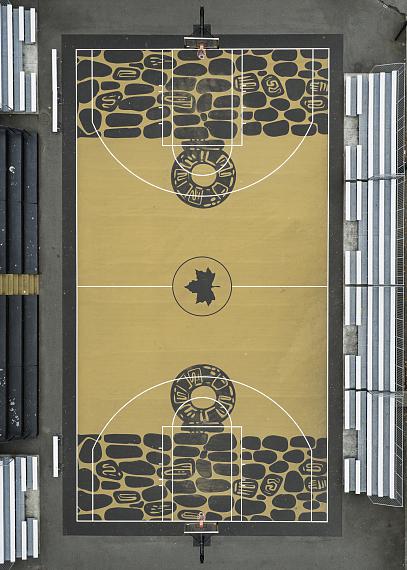
Harlem, NY, 2026
Archival pigment print on forex
80 x 109.1 cm
Edition of 3
Sean Hemmerle
"HOOPS"
Ausstellung: 21. Februar bis 18. April 2026
Eröffnung: Freitag, 20. Februar, 18 – 21 Uhr
Der Künstler ist anwesend.
Seit über zwanzig Jahren widmet sich der US-amerikanische Fotograf Sean Hemmerle
(*1966) mit seiner Serie Hoops [engl. für Basketballkorb und auch das Spiel als solches], dem Thema Basketball als internationalem, grenz-, sprach- und religionsübergreifendem kulturellem Phänomen.
Das erste Bild der Serie entstand 2003. Hemmerle dokumentierte damals Krisengebiete und war
deshalb in den Irak gereist. Beim Anblick eines Basketballfeldes in Bagdad kam ihm der Gedanke,
dass es sich – vor dem Hintergrund des umstrittenen Agierens der Bush-Administration - bei diesem
Sport vielleicht um den bedeutendsten kulturellen Export der USA handeln könnte. Seitdem hat
Hemmerle Basketballplätze quer über den nordamerikanischen Kontinent dokumentiert, von
Arizona bis New Hamshire, von Texas bis Kanada, sowie vierzehn weitere Länder in Europa, Asien,
Lateinamerika und Afrika bereist, um dort mit den Hoops das festzuhalten, was er als Symbol für "eine bessere Form der amerikanischen Diplomatie" begreift, da sie die eigentliche Vielfalt und den Geist seiner Heimat deutlich angemessener in der Welt zu repräsentieren vermögen als alle anderen
Exportgüter. Nicht das Recht des Stärkeren, sondern ein hohes Maß an Teamgeist und die
Integration jedes einzelnen Spielers in die Mannschaft zeichnen diesen Sport aus, der 1891 von
einem Kanadier in Springfield, Massachusetts erfunden wurde und während des 20. Jahrhunderts
zu einer der weitverbreitetsten Mannschaftssportarten weltweit avancierte.
Der namensgebende Protagonist der Serie - die ebenso simple wie ikonische Konstruktion
aus Ständer, Backbord und Korb - wird von Hemmerle jeweils frontal aufgenommen und in das
Zentrum des Bildes gesetzt. Doch ist es der sie umgebende Raum, der in seinen Bildern eine ebenso
große Bedeutung gewinnt, d.h. die Landschaft oder die urbane Struktur, in der sich der Hoop
befindet. Unwillkürlich beginnt der Betrachter, den Umraum - es sind ausschließlich öffentlich
zugängliche Freiplätze, die Hemmerle fotografiert - nach Hinweisen abzusuchen, die eine örtliche
Ein- und Zuordnung erlauben. Schriftzeichen sowie die landestypische Architektur, Landschaft und
Vegetation dienen hier als Anhaltspunkte.
Das stets gleiche, universelle Bauprinzip des Hoops, ob fotografiert in Hebron oder Reykjavik, in Köln oder in der Bronx, sowie der einheitliche, betont sachliche Aufnahmemodus Hemmerles laden zu einem vergleichenden Sehen ein. Dieses wird durch die Hängung der Bilder in Form eines Tableaus weiter begünstigt. Unverkennbar wird hier die Traditionslinie sichtbar, in der Hemmerles Werk steht. Die Aufnahmen Bernd und Hilla Bechers, in denen die aufgenommene Industriearchitektur zur "anonymen Skulptur" wird, sind hier ebenso zu nennen wie die New Topographics, die in ihren Bildern den Eingriffen in die vom Menschen veränderte Landschaft nachspürten.
Im Jahr 2025 begann Sean Hemmerle, die Serie durch Luftaufnahmen von Basketballplätzen zu erweitern, die er mittels einer Drohne aufnimmt. In der Aufsicht verwandelt er die Courts mit ihren zahlreichen, sich hell von verschiedenfarbigen Untergründen abhebenden Spielfeldlinien zu ästhetisch äußert reizvollen, graphisch-abstrakt lesbaren Strukturen, die – bedingt etwa durch Witterungs- oder Reinigungsspuren – eine mitunter malerische Wirkung entfalten.
Wie die frontal aufgenommenen Hoops sind auch die allermeisten Courts mit wenigen Ausnahmen
menschenleer, doch zeugen Spuren in den Bildern beider Werkreihen von denen, die die Plätze
nutzen: am Spielfeldrand abgestellter Müll, liegengebliebene Kleidung, Tags und Graffitis oder der
Reifenabrieb von Motorrädern, der sich in Form kreisförmiger, dunkler Strukturen kontrastiv über
die hellen Markierungen des Spielfeldes legt. Durch diese narrativen Elemente und bildlichen
Hinweise auf ein "Davor" gewinnen die Bilder eine zeitliche Dimension, werden sie Bausteine einer
Erzählung, die bei eingehenderer Betrachtung durch weitere Details wie abgeplatzte Farbe,
bröckelnder Asphalt, Risse, Laub und Pfützen ausgeweitet wird.
In den bislang ausschließlich in den USA aufgenommenen Courts gehen das Motiv und das
von Sean Hemmerle verwendete Material – seit einigen Jahren printed er seine digital fotografierten
Bilder bevorzugt auf einem hochwertigen Hahnemühle-Papier – eine gelungene Verbindung ein: In
der leicht strukturierten, samtig wirkenden Oberfläche des Papiers finden die Beläge der Plätze ihre
haptische Entsprechung.
Hemmerles Bilder feiern den Hoop als universelles Prinzip, als Symbol, das für
Verbundenheit, Zusammengehörigkeit und Fairplay steht und das sich, abseits jeder geopolitischen
Verwerfungen, Widerstände und Krisen, weltweit behauptet. In der heutigen Zeit anhaltender
Unruhen und Konflikte und vor dem Hintergrund der jüngsten Ereignisse in den USA zeigt sich die
Aktualität seines künstlerischen Ansatzes.
Sean Hemmerles Arbeiten wurden international ausgestellt, sie befinden sich in privaten Sammlungen (u.a. von Elton John und Martin Margulies) ebenso wie in institutionellen, darunter in der des Museum of Modern Art, New York, des International Center of Photography, New York und des Museum of Fine Arts, Houston. Seine Fotografien wurden u.a. in Time und im The New York Times Magazine veröffentlicht.
Queens, NY, 2026
Archival pigment print on forex
130 x 178.8 cm
Unique
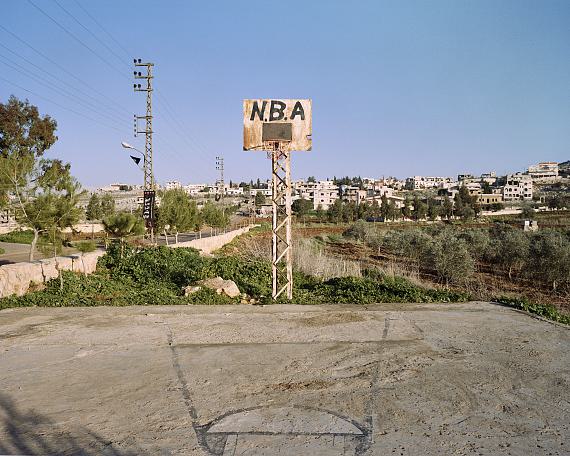
Nabatieh, Lebanon, 2007
Archival pigment print
43.2 x 52.5 cm
Edition of 5