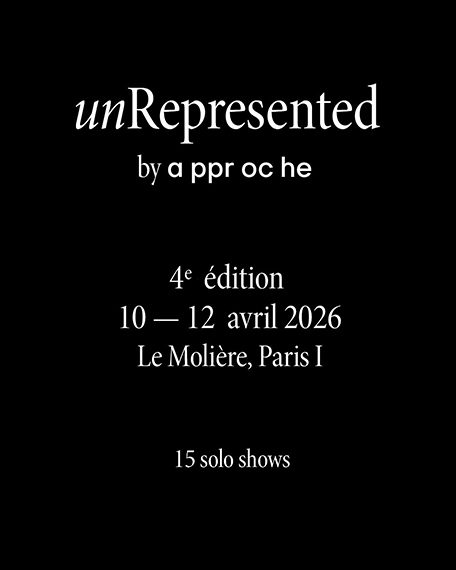
unRepresented 2026
Regina Anzenberger » Jérémy Appert » Tania Arancia » Hélène Bellenger » Emmanuelle Blanc » Carline Bourdelas » Sandrine Elberg » Claudia Huidobro » Auriane Kolodziej » Magali Lambert » Valérie Le Guern » Julien Mignot » Élie Monferier » Catherine Rebois » Laure Sée » & others
Fair: 10 Apr – 12 Apr 2026

The entire a ppr oc he team wishes you all the best and is delighted to start the new year by announcing the fourth edition of the unRepresented fair, which will be held from 10 to 12 April at the Molière in Paris.
Conceived as an extension of the a ppr oc he salon, dedicated to experimental forms of imagery, unRepresented affirms, for this new edition, its unique format dedicated to the visibility of artists not represented by galleries, whether emerging or established. The event will bring together 15 solo exhibitions, supported by artists accompanied by a community of patrons committed to providing demanding and attentive support for contemporary creation.
At the heart of the project, unRepresented highlights the fundamental role of these patrons, collectors, companies and associations, offering them a renewed approach to patronage that is both collaborative and unifying.
We look forward to unveiling the list of artists and their supporters in the near future. Join us in early April to discover new and unique proposals around the image.
Regina Anzenberger [AT] Supported by Dirk Bernhard Schmitz [DE]
Regina Anzenberger takes an interest in Vienna’s Gstettn, a wild natural area, an informal, transitional urban space, somewhere between construction and abandonment. Enhanced with paint, augmented with text or drawings, and sometimes incorporating elements collected on site, Regina Anzenberger’s photographic works blur the boundaries between photography and painting, resulting in hybrid works that are both documentary and interpretative, creating a direct link between the place of origin and its extension in the work. This invites us to consider the dynamics of landscapes and the fragile balance between human intervention and natural processes.
Jérémy Appert [FR] Supported by Anonymous
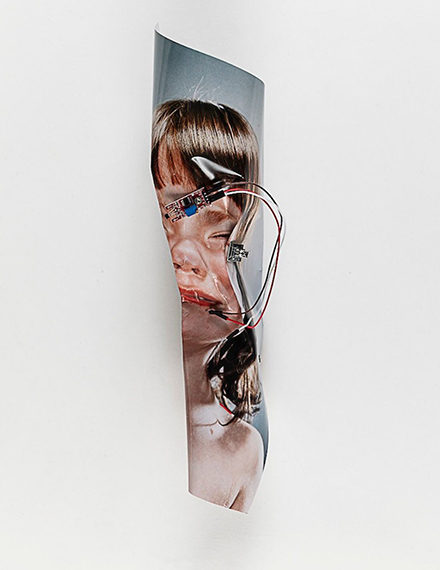
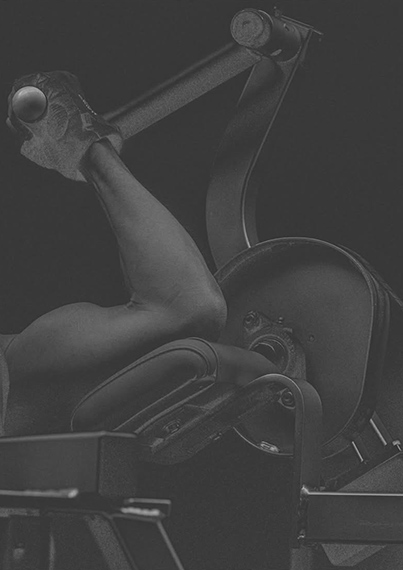
Jérémy Appert examines contemporary modes of embodiment, focusing on the human body confronted with its limits and driven by a desire for emancipation. Echoing the way machines drive bodies to their limits, he pushes photographic devices — cameras, printers, and imaging software — to their extremes in order to explore digital matter and its disturbances, opening a visual dialogue between flesh and technique, strength and vulnerability.
Tania Arancia [FR] Supported by Rubis Mécénat [FR] & La Station Culturelle [FR]
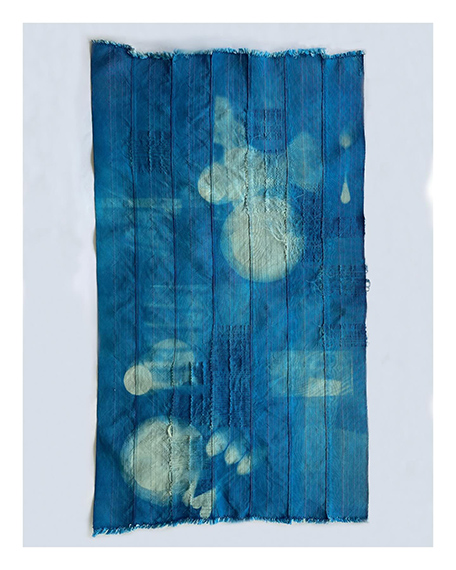
Tania Arancia’s practice is based on textile work and an intimate relationship with photography and family archives. She collects images from family archives, often modest and fragile, which she considers to be sensitive territories where ordinary yet fundamental stories are deposited. Her work bears witness to the way in which an intimate archive can become a place of poetic reconstruction. Memory is literally woven into it: each thread, each cyanotype trace, each fragment of photography paves the way for a resurgence. What remains is not the decay of memory, but the attempt to fix emotions, gestures and possibilities in living matter.
Hélène Bellenger [FR] Supported by Bureau Baillet [FR]
Hélène Bellenger’s work explores the iconic economy of Western visual culture. She conceives of the image as a surface to be activated, whose perception engages the body: reading becomes fragmentary, spatialised, non-linear and sensory. Carta Venere (Paper Venus) is a series of prints of statues on cardboard. Images of statues and sculpture studios are thus printed on a modest, recyclable medium, in tension with the symbolism of marble. She thus evokes the industrial reality of the marble quarries of Carrara while inviting us to reflect on what shapes us and the cultural construction of the gaze.
Emmanuelle Blanc [FR] Supported by Mathilde Pourquié & Anonymous
For Emmanuelle Blanc, the photographic act involves a true physical engagement:she enters the landscape, becomes one with it, in an almost performative relationship. Her photographic work seeks to convey the experiences that places bring us: the way they touch us, move us, and the strong or tenuous links that are forged between the different elements of a territory, whether it be its history or its inhabitants, human or otherwise. Her work thus fits into the perspective of a new ‘ecology of relations’ (Philippe Descola), attentive to new ways of thinking about our connections to territories and the forms
Carline Bourdelas [FR] Supported by We Are [FR]
Carline Bourdelas develops a body of work in which the image becomes a space of reverberation, memory, and inner projection. Inspired by the figure of Eve in Balzac’s Lost Illusions, this series questions the female condition and the shadowy zones of intimate narrative. The superimposition of images composes an extended, non-linear time, close to a state of rebirth or an imaginary elsewhere. The photographs settle like layers of memory, abolishing the boundary between past, present and projection
Sandrine Elberg [FR] Supported by Sophie Bordet
Sandrine Elberg invites us to explore the outer reaches of the cosmos, transporting us into extraterrestrial landscapes at the threshold between reality and imagination. Here, she offers us a sensory experience of the universe: a floating space between science and imagination. Scales become blurred, the infinitely small converses with the infinitely large, until they lose their respective contours and supports. Each piece is unique, marked by accidents and time.
Claudia Huidobro [FR] Supported by DartBLAY [FR]
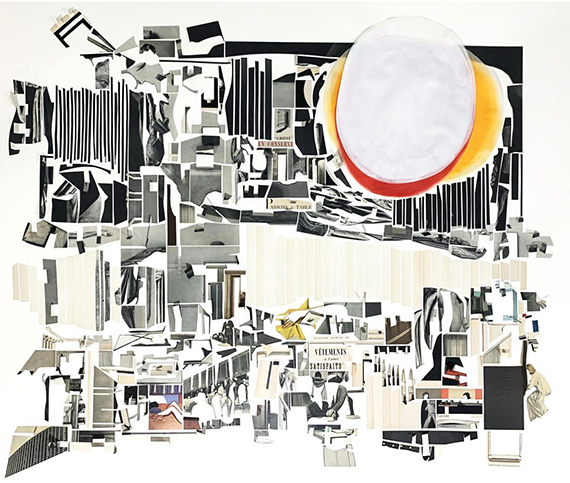
Using collage, which she has practised since her early days, Claudia Huidobro invented a fragmented, playful style, where the cut-out shapes disrupt the silence of the sheet of paper. Created between 2020 and 2024, her works feature fragments of sentences that punctuate the compositions, like a possible indication, legible, laughable... These almost automatic cut-outs are like the colours on a palette, the raw materials of her compositions. Each collage is an embroidery of shapes and rhythms, a unique journey, a stroll on paper in which the artist has enjoyed giving and blurring clues.
Auriane Kolodziej [FR] Supported by Martine Zimmermann [FR]
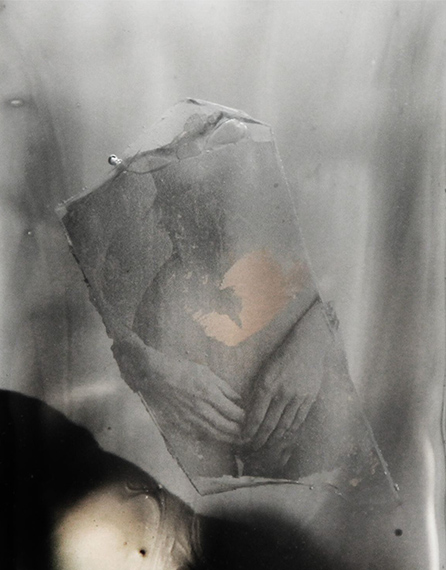
Auriane Kolodziej’s work stems from an intimate tension where existence reveals itself to be fragile, suspended at every moment between life and death. Each piece, unique, consists of a nude self-portrait transferred onto a broken and oxidised mirror, imprisoned in a block of black resin. The mirror, by nature incapable of retaining anything, is here diverted to become a support for memory: it preserves the imprint of life, suspended between appearance and disappearance. These captive nudes become shared thresholds, where the intimate meets the universal, and where the alteration of the mirror reveals the fragility of existence and its duality, always caught between light and darkness, appearance and erasure.
Magali Lambert [FR] Supported by Anonymous
Magali Lambert develops hybrid practices combining photography, drawing, sculpture, and writing, using abandoned, consumed, or neglected materials.Her work carves out a terrain where the living and the dead coexist, engaging in timeless metamorphoses. Under the bright light is the result of several years of research focused on the notion of ‘doing one’s mourning’. Here, photography traces possible paths linking life and death, memory and gesture. Whether through traditional printing or through the superimposition of cut, glued, and sewn flowers, the images converge to form extraordinary temporal loops beyond linear time.
Valérie Le Guern [FR] Supported by Amaury Mulliez [FR]
The work presented by Valérie Le Guern originated during a visit to the Gothenburg Botanical Garden, a place where the nature we contemplate is manufactured, organised and staged. The series superimposes two layers of images: on the glass of the frame, floral photographs printed on micro-perforated adhesive film. In the background, protected by the glass, is an image of gardens photographed at dusk. This liminal moment between visibility and darkness evokes nature freed from the human gaze, intact but artificialised, organised and preserved by human intervention. The framed photograph survives, while the image outside deteriorates. The device illustrates a paradox: what humans control is preserved; what they observe is altered.
Julien Mignot [FR] Supported by Jacques Deret, Art [ ] Collector [FR]
Julien Mignot pays particular attention to light, surface and duration, constructing images where stillness and movement coexist. The Temps Présent series captures the essence of a day in a single image, synthesising all the invisible colours and events. Inspired by the impact of photography on painting, it explores the relationship between time and reality. The artist records variations in the sky and ocean, compiling data to understand the formation of colours. The work invites contemplation and reflection on our place in the world.
Elie Monferier [FR] Supported by Antoine Romand [FR]
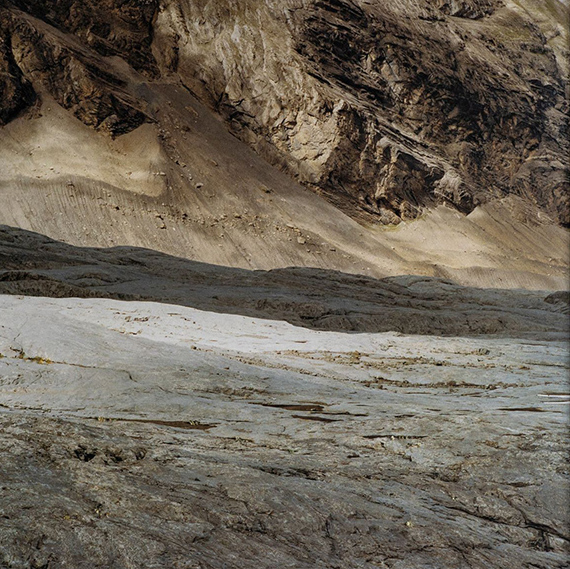
Elie Monferier presents an investigation into the mining heritage of Ariège, viewed as both a mental and geological landscape. In a region threatened by oblivion, he examines the gradual disappearance of the physical traces, archives and testimonies that constitute and circulate memory. Confronted with mining sites rendered inaccessible by changing landscapes, weather conditions, altitude and erosion, he explores how the different layers of memory affect what we can and cannot see, and how what remains hidden haunts a photographic approach that constantly refers back to the notion of loss.
Catherine Rebois [FR] Supported by LVM INSIGHT [FR]
Catherine Revois’ artistic approach is part of a critical reflection on the contemporary status of the image and its modes of production, perception and circulation. De l’épaisseur aux profondeurs (From Thickness to Depths) is a creative and research project that questions the history of photography in the age of AI. Mirroring the appropriationist movement of the 1980s (does a painter ask permission from the landscape?) and using found, fragmented and transformed photographic images, this project explores the loss of materiality, the mutations of the image, algorithmic fabrication and contemporary cultural, technological and ethical issues.
Laure Sée [FR] Supported by ANTHEM [FR]
Laure Sée’s experimental approach, somewhere between figuration and abstraction, seeks to blur the immediate reading of a photograph and question our relationship with the image. By separating the moment of capture from the moment of creation, she introduces a rupture between the photographic event and its materialisation. Laure Sée presents a series of transfers and prints on plaster. This technique provides a physical space and context for the image and invites us to reflect on the issues surrounding its dissemination. This process is an additional step in time, but also in transmission. It turns the image into an object, circumscribes it and forces the viewer to question what they are seeing.