
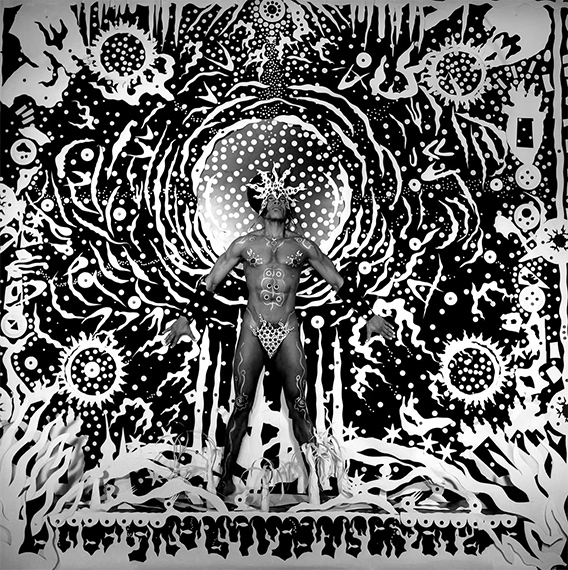
© Courtesy The Steven Arnold Museum & Archives.
Steven Arnold »
Cocktails in Heaven
Exhibition: 25 Feb – 24 Apr 2026
Wed 25 Feb 13:00
Del Vaz Projects
259 19th Street Santa Monica
CA 90402 Los Angeles
+1-310-9993060
info@delvazprojects.com
delvazprojects.com
by appt.
Steven Arnold: Cocktails in Heaven
On View February 25-April 25, 2026
Opening & Book Launch, Wednesday, February 25, 1-6 PM
Opening Week Special Hours: Thursday to Sunday, 1-6 PM
Regular Hours: Saturdays, 12-4 PM
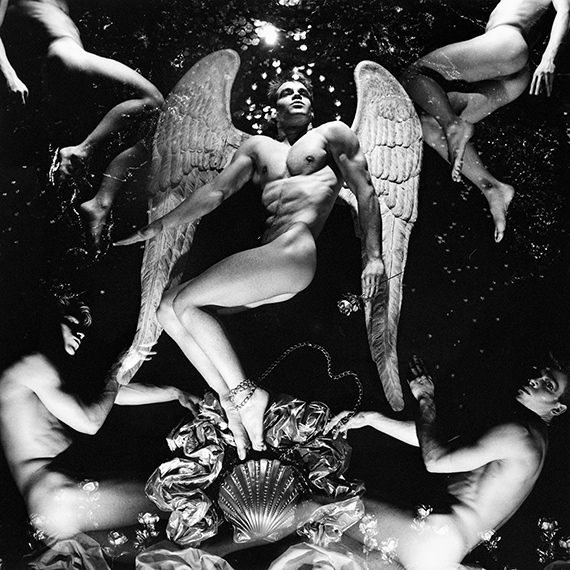
Del Vaz Projects is delighted to present Cocktails in Heaven, a landmark exhibition devoted to exploring the world-erecting, genre-bending, zeitgeist-crackling, madness-materializing, fairy-tinseled life and work of the artist Steven Arnold (b. 1943, Oakland, CA; d. 1994, Los Angeles, CA). Reflecting a kaleidoscopic practice that spanned drawing, sculpture, painting, printmaking, costuming, set design, art direction, theater, film, and photography, this installation arranges Arnold’s multidisciplinary artwork and personal ephemera to restage his legendary Los Angeles home and studio, Zanzabar. Nestled in a former pretzel factory resting beside a Victorian house at 3316 Beverly Boulevard—and named after an unconventionally spelled inscription on an antique clown mask found in a flea market in his youth—Zanzabar was an elaborate, chameleonic space where Arnold lived, hosted salons, and photographed his famed tableaux vivants (living pictures). As a queer artist who died from AIDS-related complications in 1994, and whose archive has had limited public engagement for the last several decades—now housed in the collection of the ONE Archives at the USC Libraries—this exhibition offers a rare and panoramic portrait of his inimitable career, which is deserving of a profound and thorough reexamination.
Attempting to encapsulate Zanzabar, Arnold once explained, “My studio is more like Barnum and Bailey fucks Louis the Fourteenth, in drag. . . . All the atmosphere around here is illusion, cardboard Pic-N-Save illusion. It has nothing to do with status and everything to do with faking it, with theater.” Conjuring what he described as the “flatitude” of cinematic sets, the tableaux he composed at Zanzabar were black-and-white photographs printed in the layout of Tibetan thangkas—portraits deifying his queer, celebrity, and counterculture communities through scenes of sublime, surreal, and androgynous splendor. Boisterous and makeshift, his shoots stretched late into the night and entailed enlisting friends for help with hair and makeup; scouting models everywhere from his intimate cohort to club dance floors; borrowing costumes from designers Kaisik Wong, Alex & Lee, and R.A.L. West (all of whose work is on view in this show); and bricolaging backdrops from sidewalk detritus draped in rich fabrics, dime-store trinkets spray-painted gold, and cardboard kingdoms collaged in marbled paper. His photographs were staged with all hands on deck, produced with little funds, and captured in very few shots, but the click of his Hasselblad resounded like the clink of a rosary bead in the hand of a shaman—a regal resourcefulness.
From Catholicism to Art Nouveau and Egyptomania, Arnold’s pick-and-choose, East-meets-West style reflects what Mike Kelley defined as a “pastiche aesthetic” in his essay “Cross Gender / Cross Genre”—a sensibility he felt was “the primary signifier of psychedelic culture. . .promot[ing] confusion while at the same time postulating equality[.]” A love child of California’s myriad twentieth-century subcultures, Arnold straddled the bohemianism of the beatniks, the LSD fantasy of Haight-Ashbury, the devotion of the occultists, and the faux grandeur of Golden-Age Hollywood. Early in his career, when he organized the midnight movie series “The Nocturnal Dream Shows” at the Palace Theatre in San Francisco—where he gave the avant-garde theater troupe The Cockettes their debut performance as an opening act—he programmed art-house cinema alongside cult classics and cartoons. The films he made reflect a palate ranging from George Méliès’ A Trip to the Moon to Kenneth Anger’s Inauguration of the Pleasure Dome; the posters he designed for stores, clubs, and theaters emulate the Decadence of Aubrey Beardsley and the New Objectivity of the Weimar Republic; the snapshots he captured evidence a milieu that intersected Holly Woodlawn, Timothy Leary, Sylvester, Joni Mitchell, Mundo Meza, Debbie Harry, and Divine.
Though exemplified in every material he used, the anatomy of Arnold’s aesthetic is most evident in his drawings—this exhibition marking the first significant presentation of his works on paper. Understood as a technical process and a spiritual philosophy, all of his artwork originated in drawing: for each tableau there is a sketched set; for each play there is a scribbled costume; for each film there is a jotted storyboard. Over any other medium he worked with, through drawing he broke the dam of genre and let his visions flow intuitively and freely. He absorbed cinema, art history, sexuality, science fiction, mythology, and religion, churning them together in unwavering graphic lines. In one notebook, he confided to himself, “With these drawings, I hope to probe my innermost symbols and fantasies. . . . It is a struggle to overcome technical consciousness—to free myself from style. My objective is to overcome this self-consciousness and deliver directly and completely my purest moments.” Never lifting his pen from the page until his chimeric figure or otherworldly landscape was complete, his drawings were an exercise in enlightenment. On paper alone, he invented fresh religions, appointed new gods, and consecrated novel temples—every stroke a ripple in the gurgling stream of his consciousness.
Steven Arnold (b. Oakland, CA, 1943; d. Los Angeles, CA, 1994) was a visionary artist working across drawing, sculpture, painting, printmaking, costuming, set design, art direction, theater, film, and photography. He studied at the San Francisco Art Institute, where he received his BFA in 1966 and MFA in 1969. Over the course of his career, he created three short films and one feature, Luminous Procuress (1971). Arnold’s life traversed the epoch of twentieth-century counterculture, creative, and celebrity social scenes in San Francisco, New York, France, Morocco, Spain, and Los Angeles—where he established his home studio, Zanzabar. In 1988, Arnold was diagnosed with AIDS, which he died from complications of in 1994. Arnold’s artwork is in the collections of the Getty Museum, Los Angeles; Museum of Modern Art (MoMA), New York; Tang Teaching Museum, Saratoga Springs, New York; Whitney Museum of American Art, New York; Leslie Lohman Museum of Art, New York; Museum of Contemporary Art (MOCA), Los Angeles; Los Angeles County Museum of Art (LACMA); Cinémathèque Française, Paris; Cincinnati Art Museum, Cincinnati, Ohio; Oakland Art Museum, Oakland, California; and San Francisco Museum of Modern Art (SFMoMA).