
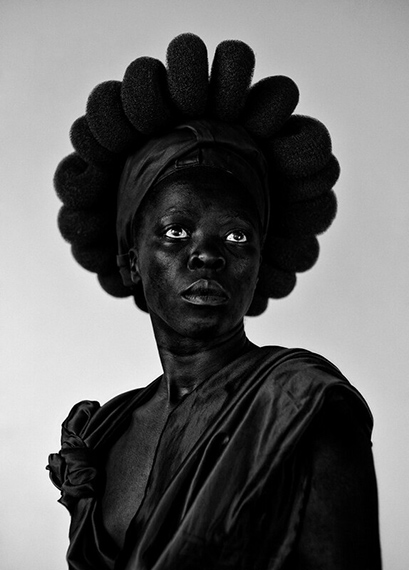
© Zanele Muholi. Courtesy of the artist and Yancey Richardson, New York and Southern Guild, Cape Town.
Zanele Muholi »
Hasselblad Award Winner 2026
Exhibition: 10 Oct 2026 – 4 Apr 2027
Hasselblad Center
Ekmansgatan 8 / Götaplatsen
412 56 Göteborg
+46 31-203530
web@hasselbladfoundation.org
www.hasselbladfoundation.org
Tue, Thu 11-18 . Wed 11-21 . Fri-Sun 11-17
The Hasselblad Foundation is delighted to announce that Zanele Muholi is the 2026 Hasselblad Award laureate.
Zanele Muholi:
This prize is not mine alone. I carry it with the many faces, names, and histories that have trusted me with their stories. From Umlazi to every space where Black LGBTQIA+ people continue to fight to exist freely, this recognition affirms that our lives are worthy of being seen – not as statistics, not as shadows, but as full human beings. For years, my work has been about visibility and resistance. It has been about creating an archive so that no one can say, ‘We did not know.’ When this honour comes, I receive it on behalf of my community; those who have been erased, those who are still here, and those who are yet to see themselves reflected with dignity.
About the Hasselblad Award
Zanele Muholi receives the world’s largest photography award, consisting of SEK 2,000,000, a gold medal, and a Hasselblad camera. The laureate is honoured with a solo exhibition at the Hasselblad Center from 10 October 2026 until 4 April 2027, along with a series of events during Hasselblad Award Week in Gothenburg, including a seminar in collaboration with the County Administrative Board of Västra Götaland; a concert with the Gothenburg Symphony Orchestra; an exhibition opening; a book launch and a formal award ceremony on 9 October. The week concludes with an artist talk at Moderna Museet in Stockholm on 13 October.
The Hasselblad Foundation’s citation regarding the Hasselblad Award laureate 2026, Zanele Muholi:
Zanele Muholi stands as one of the most influential contemporary photographers, with an impact that reaches far beyond the art world. They use portraiture to articulate and celebrate the presence, depth, and dignity of the Black LGBTQIA+ community in South Africa and the rest of the world. Born in 1972 during the apartheid regime, they are highly aware of the power of narration in the face of systematic violence. Muholi’s photographs are formally compelling, employing composition, colour, greyscale, and lighting to create an adept visual language that holds both strength and vulnerability. The portraits foreground individuals with a direct and dignified gaze, challenging prejudice and discrimination while creating alternative visual histories. Activism and community work is an integral part of their practice, which combines political urgency and formal mastery, making Muholi a central figure in global queer visual culture.
Zanele Muholi talks about their work and being the 2026 Hasselblad Award laureate. Recorded in Gothenburg, February 2026.
www.hasselbladfoundation.org
About Zanele Muholi
Zanele Muholi (she/they) was born in 1972 in Umlazi, Durban, and currently lives and works between Johannesburg and Cape Town. They studied Advanced Photography at the Market Photo Workshop in Johannesburg and completed an MFA in Documentary Media at Ryerson University, Toronto, in 2009.
Zanele Muholi has paved new ground in their use of photography in visual activism, first and foremost in a relentless fight for claiming visibility, dignity and respect for Black queer subjects. Their practice is a fearless confrontation of the silencing and discrimination, particularly in their native South Africa. Their long-term portrait series, Faces and Phases (2006–), was conceived as an act of resistance against systemic violence. The project has entered its 20th year and is now considered a seminal body of work in contemporary photography. Other works include the early Only half the Picture (2003-4), which documented lesbian lives and hate-crime survivors, and Brave Beauties (2014–), which honours trans women. In the ongoing self-portrait series Somnyama Ngonyama (Hail the Dark Lioness) (2018–), Muholi uses the visual languages of classical portraiture, fashion, domestic labour, and ethnographic imagery to challenge stereotypes and historical representations of Black bodies in visual culture. These bold self-portraits have redefined visual strategies around identity and empowerment.
As an integral part of their artistic practice, Muholi is committed to collective empowerment and knowledge-building. Inkanyiso was founded in 2009 as a forum dedicated to queer and visual activist media, and The Muholi Art Institute (founded in 2022) aims to support and develop emerging artists across diverse disciplines. Muholi’s work is central to contemporary debates on race, representation, activism, and human rights. They have been foundational for a new generation of queer and Black photographers and inspire emerging artists to work politically, ethically, and with community engagement.
The Hasselblad Award Jury 2026
The jury, which submitted its proposal to the Hasselblad Foundation’s Board of Directors this year consisted of:
Anna Planas, Jury Chair, Artistic Director, Paris Photo, Paris
Johan Sjöström, Curator, Gothenburg Museum of Art, Gothenburg
Oluremi C. Onabanjo, The Peter Schub Curator, Department of Photography, Museum of Modern Art, New York
Raquel Villar-Pérez, Independent researcher, writer, and curator. PhD candidate at the Edinburgh College of Art, University of Edinburgh, Edinburgh
Shoair Mavlian, Director, Photographers’ Gallery, London
Tawanda Appiah, Curator, Skånes konstförening, Malmö
The exhibition at the Hasselblad Center is on view from 10 October 2026 – 4 April 2027.
Curators: Louise Wolthers and Dragana Vujanović Östlind from the Hasselblad Foundation, with Lufuno Ramadwa from the Muholi Art Institute.
For the fifth consecutive year, the Hasselblad Foundation is collaborating with the Gothenburg-based camera company Hasselblad, which honours this year’s award recipient by including a new camera as part of the prize.
The History of the Hasselblad Award
In 1980, Lennart Nilsson became the first recipient of the Hasselblad Award. With the exception of 1983 and 2021, the award has been presented annually ever since.
To be considered for the Hasselblad Award, the photographer must have been recognised for “outstanding achievements in photography,” in accordance with the last will and testament of Erna and Victor Hasselblad. The recipient should also have made pioneering contributions to photographic art, had a decisive influence on younger generations of photographers, carried out several internationally significant photographic projects, and continued to develop artistically.