
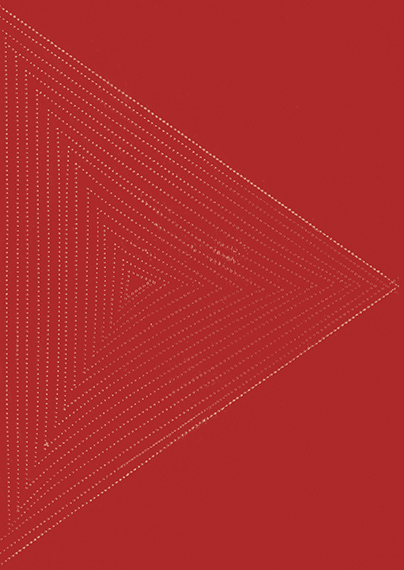
2019, silver gelatin print, 35.56 27.94 cm, unframed
Yto Barrada »
Comme Saturne
Exhibition: 9 May – 22 Nov 2026
Venice Biennale - FRANCE
Giardini
30124 Venezia
+39-41-2728397
61st International Art Exhibition – La Biennale di Venezia
French Pavilion
COMME SATURNE
by Yto Barrada
In the Renaissance, artists were said to be born under the influence of Saturn, planet of melancholy, withdrawal and slow thinking. With Comme Saturne, Yto Barrada taps into this cosmological imaginary, extending it to rites and myths, while being guided by wordplay across several languages.
Before unfolding in the pavilion’s spaces, Comme Saturne takes shape through an experimental process based on association and constraint. Yto Barrada proceeds through successive shifts: one word leads to another, a technique opens onto a myth, a colour evokes a material history, an error becomes a gesture. Language games around textile, chromatic research, literary references and systems of rules—each serving as creative levers.
The title also refers to the famous phrase: “Like Saturn, the Revolution devours its children,” that Pierre-Victurnien Vergniaud, a figure of the French Revolution, pronounced at his trial in 1793, shortly before being decapitated. Dévoré, also known as burn out, is a textile finishing technique that provided Yto Barrada with a paradoxical and unsettling starting point for her new research.
The pavilion unfolds as a suite for Saturn, following the logic of dorica castra, a literary device built on sequence and repetition. At the threshold, in a liminal space between interior and exterior, a goatskin kite symbolically connects sky and earth and opens a ritual passage into the exhibition. The visitor then enters a draped interior, an architecture of time made of folds.
The Room of Folds is dressed with large wool broadcloth drapes, partially activated by a mechanism and fading with daylight over the course of the exhibition. Following a non-linear conception, cosmic time merges with Cronos’ mythical time; that of generation and destruction, of continuity and loss. At the centre of the space, Barrada places a wheel of rules and constraints, borrowed from the OuLiPo (Workshop of Potential Literature).
The Work Room explores the Saturnalia, moments of reversal of gender and hierarchies in which power is laid bare. In The Study Room, this reflection is extended through an agricultural and cosmic detour grounded in The Mothership, the dye garden created by the artist in Tangier. Barrada champions the ethics and labour of natural colouring in the face of industrial processing and synthetic colours. Far from an ideal of purity, colour becomes knowledge collectively shared among artists, craftspeople and gardeners.
Finally, the Room of the Dévoré condenses saturnian violence. Through a textile technique in which the material is literally eaten away by an acid (devouring it), Barrada stages an economy of fragmentation. Wear, abrasion and formlessness become aesthetic and political strategies.
Comme Saturne offers less of an escape than a tool for poetic survival, at the confines of irony, anxiety and earnestness—a way not to remain melancholic, but rather to lucidly inhabit an unstable world.