
Aline Bouvy »
La Merde
Exhibition: 9 May – 22 Nov 2026
Arsenale, Sale d’Armi, 1st Fl
Campo Della Tana 2169F
30122 Venezia
Aline Bouvy (b.1974, Watermael-Boitsfort, Belgium) is a Luxembourgish artist who lives and works in Brussels and Luxembourg. She studied at the ERG – École de Recherche Graphique in Brussels and the Jan van Eyck Academie in Maastricht. Her multidisciplinary practice questions social structures, normative systems, and the power mechanisms that control behavior and desire.Working with detailed formal systems, a rigorous aesthetic, and a decidedly quirky sense of humor, the artist explores how certain norms—especially those related to gender and the body, or to the understanding of cleanliness and dirtiness—establish hierarchies, induce exclusion, or create invisibility. Her projects are inspired by the contexts in which they are exhibited, exploring narratives or images deemed marginal, inappropriate, or unsuitable.
Aline Bouvy describes her approach as an expression of artistic freedom that refuses to adapt to society’s expectations, thereby causing friction with its very presence. For her, shame is an area of instability between order and chaos, between the body and its appearance, between symbolism and substance.In response to the resurgence of exclusionary mechanisms in contemporary society, Aline Bouvy’s project, presented at the Biennale Arte 2026, emerges as a coherent choice, transforming the pavilion into an immersive and reflective artistic experience.
La Merde – Presentation of the film project
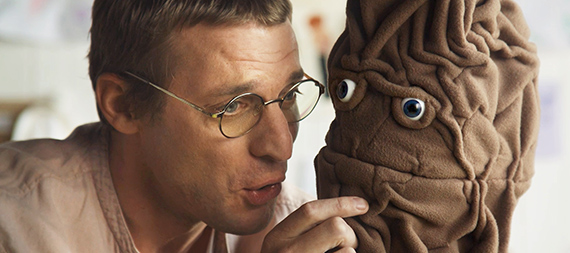
At the Biennale Arte 2026, Aline Bouvy presents La Merde, a film project that is in line with her artistic reflections. The film features a main protagonist—an anthropomorphic excrement figure that, by turns, materializes as a puppet, a 2D animation, a mere trace, and an embodied character. The spectators follow them through various stages of their life: during a hygiene lesson in a classroom their existence comes to serve as a teaching tool; on a tram ride they are restrained, shoved, and made invisible in the public space; in a bar, intimacy and desire become the grounds for negotiating their own body; in a bedroom their solitude reveals the attrition of self-restraint; and finally in a public performance, based on Dan Graham’s Identification/Projection (1977), they comes face-to-face with an audience and a system that leads to judgement, unease, and identification.Between the scenes, archival images are blended in, drawn from art history, popular culture, scientific illustrations, and the internet, showing bodies as they relieve themselves, expel dejections, lose control, and transgress cleanliness. These documents create a collective memory of the things society tries to relegate to the sidelines—a history of gestures of rejection, their uses, and their moral treatment.
La Merde is a film that explores shame as a social construct and exposes the thresholds at which humans are categorized, tolerated, repressed, or excluded. Through the figure of the anthropomorphic excrement, the film analyzes the way society produces bodies over which it demands control and restraint. When restraint gives way, not through choice but because a limit has been reached, the situation changes dramatically: that which has been contained, shows its true nature and reveals itself in broad daylight. It leads to a discharge—political, physiological, emotional—where the internalized violence outs itself in the same way in which it was inflicted.La Merde is a Rabelaisian farce in which the anthropomorphic excrement serves to criticize the place of abjection in Western culture. Here, shame functions as a moving line between inclusion and rejection, between visibility and invisibility. The film is part of a broader theoretical reflection in which abjection is seen as blurring categories, threatening the coherence of the subject, and exceeding the symbolic framework of cleanliness, form, and control. Waste—whether material, emotional, or symbolic—becomes a vector of subversive energy. The figure of the anthropomorphic excrement experiences grotesque, pathetic, ironic, and tender moments, revealing the mechanisms behind rejection and the areas where they crack.
La Merde can be seen as a feminist manifesto in the form of a cinematographic essay, an exploration of shame as a social construct, but also as a potential response to the systemic violence that shapes bodies and behavior.An immersive audiovisual installationThe audiovisual installation—which consists of a 4.5 by 2-meter high-resolution LED screen set up in the Pavilion—employs cinematography reminiscent of a feature film and uses the conventional codes of cinema. The film team and cast were selected by the artist, film director, and screenwriter Aline Bouvy. It includes co-screenwriter François Pirot, external eye Tanguy Poujol, director of cinematography Olivier Boonjing, and actors Marie Bos, Damien Chapelle, Lucie Debay, Marc Guillaume, and Louise Manteau; 2D animation by Lora D’Addazio, visual effects by Boris Wilmot, and editing by Laurence Vaes. La Merde is a coproduction by Casino Luxembourg – Forum d’art contemporain, escautville, and Salzburger Kunstverein.Sound plays an essential role in the installation. It was designed in partnership with sound engineer and composer Pierre Dozin, with whom the artist has collaborated for many years.The design uses cutting-edge audio spatialization tools that evolve and transform in real time.The acoustics were designed to create an anthropomorphic, lively, almost autonomous entity,a space that is in constant flux, blurring the lines between the soundtrack and the surrounding space. The audience is immersed in a dynamic soundscape, a unique experience where the audio unfolds freely.
To ensure full immersion, a soundproofed, semi-circular structure was designed in collaboration with architect Antoine Rocca and Ateliers Arseni (Brice Dreessen). It consists of a pre-existing, newly adjusted version of the work Wall (2025-26), a mirror-glass and steel structure produced for Bouvy’s solo exhibition Hot Flashes at Casino Luxembourg in 2025. The mirrored surface creates layers of reflections, blurring the perception of the surrounding space and of one’s own place within it, entangling the relationships it forms.The augmented visual experience is enhanced by a sculpture representing an imaginary character. Exposing yourself, being yourself, or being someone else leads to an extraordinary experience. An alter-ego in the body of a utopian mutant, where the appearance of the extra-terrestrial from Steven Spielberg’s iconic film E.T. the Extra-Terrestrial (1982) merges with the face and body of the artist and becomes E.T. The Excremential (title of the sculpture). As a modern, popular tale of difference and otherness, the sculpture resonates with the film in its engagement with the abject. La Merde is an immersive audiovisual installation that combines film, sound, and sculpture into a hybrid experience. The scene is set; an inner upheaval may arise.