
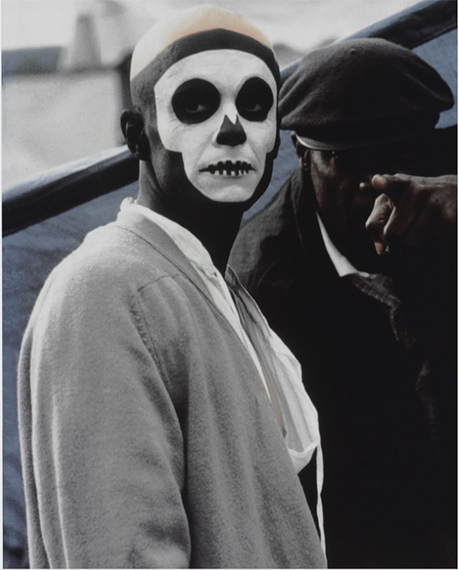
Chromogenic color print on aluminum
Private collection © Arthur Jafa / Midnight Robber © Photo: Ian Watts.TV.
Helter Skelter
Arthur Jafa » Richard Prince »
Exhibition: 9 May – 23 Nov 2026
Sat 9 May 18:00

Fondazione Prada
Ca' Corner della Regina
30135 Venezia
+39 041 -810 9161
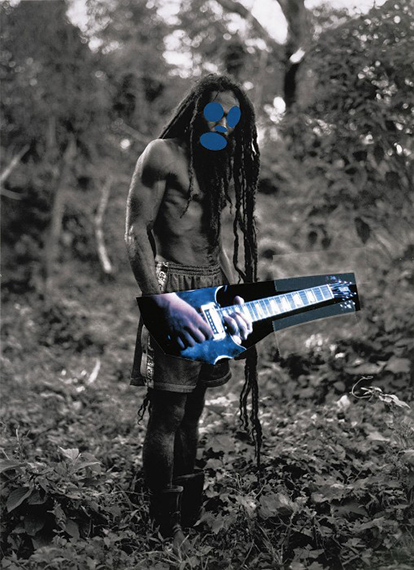
Collage, inkjet, and acrylic on canvas,
72 ¾ × 52 ½ inches (185 × 133 cm)
Collection of Larry Gagosian © Richard Prince
“Helter Skelter: Arthur Jafa and Richard Prince” is an exhibition curated by Nancy Spector at Ca’ Corner della Regina in Venice, which reveals a creative conversation between the work of two prominent American artists, Arthur Jafa (b. 1960) and Richard Prince (b. 1949), that has never been examined before.
Born a decade apart, they share an ethos of lawlessness when it comes to the appropriation and manipulation of images siphoned from movies, pulp novels, comic books, YouTube videos, sci-fi stories, album covers, record sleeves, rock ‘n’ roll posters, first-edition Beat volumes, news reels, celebrity memorabilia, and social-media posts. Trafficking heavily in American popular culture, they expose its grit and grift, while embracing many of its myths and perversions. Both artists chart peculiar topographies specific to the United States: Jafa’s reflecting his identity as an African American man, coupled with a mission to invigorate Black cinema and art; Prince’s hovering between a self-conscious critique of white masculinity and a fascination with the underbelly of the American psyche.
The exhibition features more than fifty works, including photographs, videos, installations, sculptures, and paintings. It will also showcase new work by each artist and a collaboratively conceived zine, which incorporates images exchanged between the artists during the process of making this exhibition.

Digital C-print 60 x 75 7/8 inches (152.4 x 192.7 cm)
Ignace and Isabellle Vandenabeele – De Bruyn © Arthur Jafa
“Helter Skelter” unfolds across the ground and first floor of the Venetian palazzo through a series of thematic and conceptual juxtapositions, combining works by both artists to illuminate each of their practices and tease out shared subject matter and mutual obsessions. Underlying the elective affinities between their artistic projects, “Helter Skelter” reveals a certain vernacular edge in the U.S., where both artists live and work: “A country forever tarnished by its history of slavery; a country defined by its remarkable musical traditions rooted in Black culture; a country of doing without, but making good; a country of spirit and prayer and freedom of expression; a country of protest and subcultures and humor and celebrity,” according to Nancy Spector.
As clarified by Spector, “Both artists have cited Marcel Duchamp’s readymade, a radical transposition of objects from the real world into an art context, as a source of inspiration or, at least, a reference point for their respective practices. In his shift from making (having initially produced paintings in a Cubist mode) to taking (placing a commercially fabricated, inverted urinal in an exhibition framework), Duchamp modeled a kind of artistic piracy that constitutes the very DNA of Jafa’s and Prince’s discrete but tantalizingly analogous methodologies. They are both image scavengers. Seeking no prior permission, they dip into the overflowing reservoir of visual culture—from the swamps of social media to the annals of print journalism, from advertising’s hall of mirrors to Hollywood’s celluloid archive—to take whatever they want and convert it into art by choice alone. […] What comes into focus through the refracting lens of Jafa’s and Prince’s appropriation-based practices is an unflinching exposé on America. They are quintessentially American artists in subject and medium, literally enfolding objects and images from the empirical world into their works, subsuming them as readymades—Trojan horses, as it were, designed to disrupt established belief systems.”
The exhibition’s title, “Helter Skelter,” functions as a palimpsest of meanings and references. Originating from a British amusement park ride, the phrase is also a colloquialism for chaos. It is the title of a famous 1968 song by Paul McCartney, released on the LP The Beatles, better known as The White Album. In late 1968, cult leader Charles Manson appropriated the term to predict an imminent apocalyptic race war, in which African Americans and whites would essentially annihilate one another. “Helter Skelter” was also the title of a 1992 exhibition at the Museum of Contemporary Art, Los Angeles, which notably excluded Black visual artists. The term “Helter Skelter,” reinvoked here as the title of this exhibition, contains all the complexity and messiness of its misuse in popular culture. It is an unruly readymade, selected by the artists to disrupt expectations, a perfect expression of the composite nature of this two-person show.
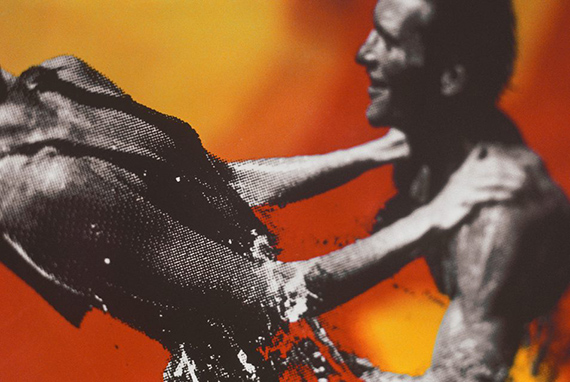
Chromogenic print sheet: 29 3/4 in. × 45 in. (75.6 × 114.3 cm)
framed: 38 1/8 × 53 5/8 × 1 3/8 in. (96.8 × 136.2 × 3.5 cm)
Private Collection © Richard Prince