If All Time Is Eternally Present
Collateral Event of the 61st International Art Exhibition – La Biennale di Venezia
Orian Barki » Meriem Bennani » Tai Shani » Kandis Williams »
Exhibition: 9 May – 7 Jun 2026
Wed 6 May 20:00
Palazzo Nervi Scattolin
Campo Manin, San Marco 4866
Venezia
On view each night from 8:30pm - 11:00pm
The Pier Luigi Nervi Foundation
Campo Manin, San Marco 4866
Venezia
+39-41-
On view each night from 8:30pm - 11:00pm
Pier Luigi Nervi Foundation presents:
If All Time Is Eternally Present
Kandis Williams, Meriem Bennani & Orian Barki, Tai Shani
Curated by Chiara Carrera and Marta Barina
Palazzo Nervi Scattolin, Campo Manin, Venice
Collateral Event of the 61st International Art Exhibition – La Biennale di Venezia
9 May–7 June 2026
Public Opening: 6 May, from 8:00pm–11:00pm
Press Days: 7-8 May
On view each night from 8:30pm - 11:00pm
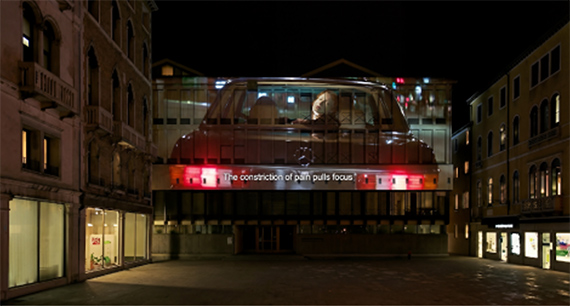
Pier Luigi Nervi Foundation presents If All Time Is Eternally Present, an exhibition of new and existing moving image works by Kandis Williams, Meriem Bennani & Orian Barki, and Tai Shani, staged on the façade of Palazzo Nervi Scattolin, with the exclusive support of Bottega Veneta.
A Collateral Event of the 61st International Art Exhibition – La Biennale di Venezia, the exhibition is a nocturnal encounter between moving image, architecture, and public space. It is the first in a cycle of exhibitions which foster a dialogue between artistic practices and the built environment, as part of the Foundation’s long-standing commitment to the promotion, conservation, and critical rethinking of Pier Luigi Nervi’s legacy.
Pier Luigi Nervi (1891–1979) is renowned for architectural forms that fuse art with engineering. At the core of his work is the principle that each structural element derives its form from the forces acting within it, giving visible expression to an otherwise invisible structural logic. Palazzo Nervi Scattolin – one of the few examples of Venetian modernism – was commissioned in the early 1960s, as the new home of the Cassa di Risparmio di Venezia, and completed in 1972. For Nervi, it was an opportunity to engage directly with contemporary debates on modernity, articulating an architectural stance grounded in the critical exploration of radical ideas. Reconsidered today, Palazzo Nervi Scattolin brings into focus a brief yet intense moment in Venetian history, when the city looked toward its future by imagining unprecedented models of cultural, urban, and social renewal, with architecture playing a central role. It also recalls Venice’s transnational cultural identity and the fertile climate of the early 1970s, when the city was deeply engaged in a transatlantic exchange with other dynamic urban centres — most notably another exceptional island city: New York
Titled If All Time Is Eternally Present, the exhibition offers an interpretation of Nervi’s architecture as a speculative tool through which to interrogate the contemporary condition. The title is borrowed from T. S. Eliot’s Four Quartets – a collection of poems which explore humanity’s relationship with cyclical time, the universe, and the divine, rooted in a eulogy of “presentness” as the space of encounter between past and future. Similarly, the exhibition presents a throughline between the historical dimension of Nervi’s legacy and the contemporaneity of the three video works projected across its external façade. Each of the three works act as subjective readers of a collective condition, offering critical tools to address and reframe the present – much as Nervi’s architecture did in its own historical moment.
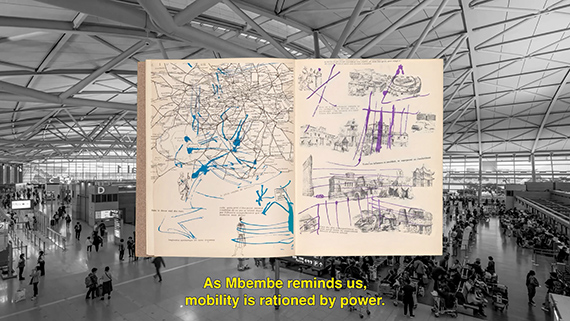
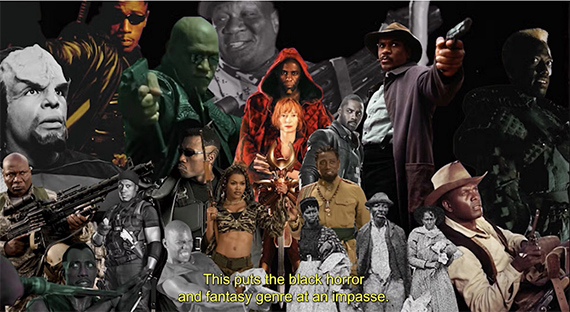
A Travel Guide: Black Gothic in South Korean Horror (2025), is a new work by Baltimore born and Berlin based artist Kandis Williams (b. 1985) that looks at both historical and contemporary regimes of power, surveillance, racialised governance, and inherited violence. Structured as a multi-source collage – part travel journal, research essay, and stream of associative thought – the film tracks Williams across South Korea, following the interflowing of Black and Korean musical forms – from jazz and hip-hop to K-pop – and finding links between Black and South Korean collective memories. Tracing intercultural resonances across histories of militarisation, state violence, suppressed mourning, and the lack of reconciliation, Williams examines the politics of movement while critiquing the aestheticisation of Black pain in visual and digital cultures.
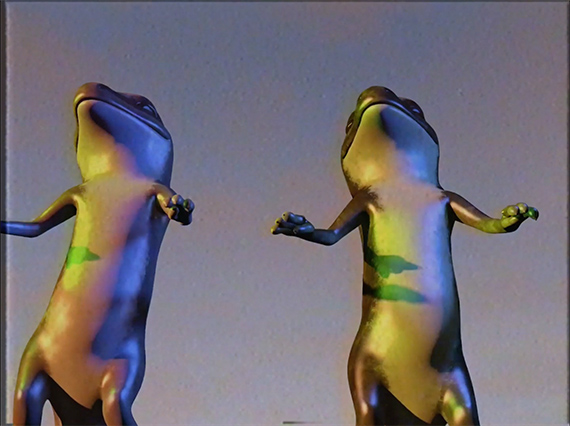
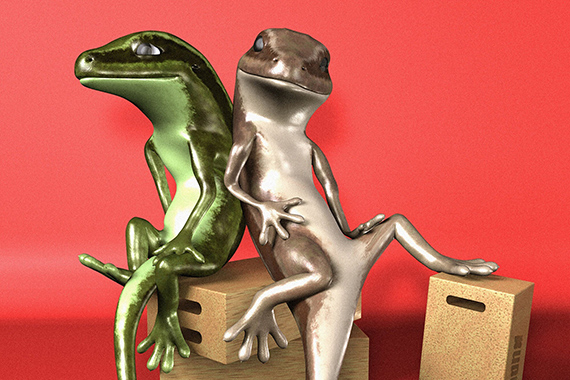
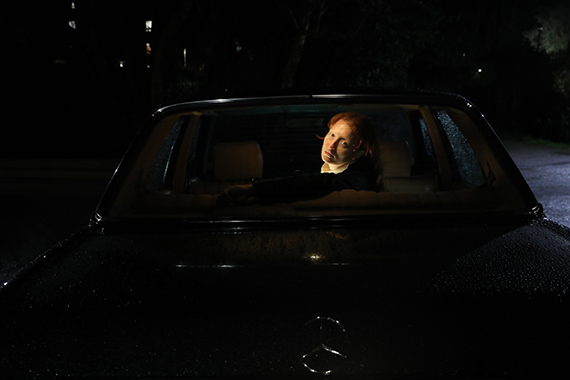
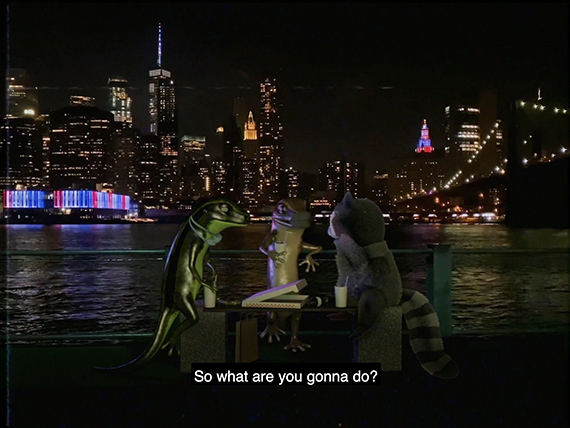
Made during the early months of the COVID-19 pandemic, Meriem Bennani & Orian Barki’s 2 Lizards (2020) is an eight-part animated video series. The project refracts the upheaval of life in New York through the eyes of two anthropomorphic lizard avatars voiced by Bennani and Barki. The tone is playful yet piercing, ironic yet empathetic: formally, the piece exemplifies Bennani’s wider practice of intertwining global popular culture with digital technology and diasporic imaginaries, blending live action with 2D and 3D animation that pulls from documentary, science fiction, phone footage, music videos and reality TV. By animating creatures who speak with irreverent humanity, 2 Lizards turns intimate, anecdotal experiences into a universal narrative. Boredom, absurdity, fear and fleeting joy become shared emotional currencies for anyone who lived through that strange, liminal phase, where connection was negotiated not through place but through shared experience.
Tai Shani’s My Bodily Remains, Your Bodily Remains and All the Bodily Remains that Ever Were and Ever Will Be (2023–2026), is a new production derived from the 2023 film of the same title co-commissioned by Art Night (London), CAC Cincinnati, KM21 (The Hague), and POR:TA (Portugal). The film features an original score composed by Maxwell Sterling and Richard Fearless, alongside digital animations by Adam Sinclair. The work draws on key scenes and figures from the original film - including the Ghost for Revolution and the Book of Love - interwoven with a new 3-D animation oscillating between underwater sequences and aerial views of a desert landscape. It unfolds as a technicolour, speculative dream shaped by cinematographic and gaming aesthetics, sci-fi, and spectral registers, reflecting Shani’s ongoing research into non-sovereignty, collective embodiment, and radical affect. Love, grief, and political transformation are articulated through a chorus of voices and embodied presences, framing love and pleasure as emancipatory forces.
Palazzo Nervi Scattolin, as a reflection on contemporaneity, resonates with the practices of Williams, Bennani & Barki, and Shani. The nocturnal condition of the exhibition shifts traditional modes of spectatorship from consumption to encounter. The discourse, too, shifts. A public dimension is opened up; the projections not only create the conditions for dérive and wonder, but generate a spatial experience in which they are fundamentally altered – by the interaction of image, space, body, and context – in their conditions of appearance and reception. By using the iconic exterior of the building as a scenographic device, the works become part of the fabric of the city, highlighting intersections of public and private life, identity, power, globalisation, migration, and surveillance. The exhibition does not merely reflect these complexities, but renders them visible and intelligible. This encounter between the artworks and the building creates a site-specific reflection of Venice as both a historical and contemporary space, where tradition and innovation coexist and can be critically reimagined. To the artists we turn as the best interpreters of our time in its most sensorial, emotional, and subjective interpretation, in full accord with Biennale Arte 2026 theme, In Minor Keys.
If All Time Is Eternally Present: Kandis Williams, Meriem Bennani & Orian Barki, Tai Shani is curated by Chiara Carrera and Marta Barina, commissioned by the Pier Luigi Nervi Foundation and made possible thanks to the exclusive support of Bottega Veneta.
Kandis Williams (b. 1985, Baltimore; lives in Berlin) is an artist whose practice spans collage, dramaturgy, writing, and publishing centering the body and movement as tools to examine the biopolitical dynamics of representation. She is the co-founder of the publishing platform Cassandra Press, through which she critically engages with the history and representation of Black and female bodies. Major solo exhibitions include an upcoming presentation at the Serpentine Gallery, London (2027) and Rockbund Art Museum, Shanghai (2026), as well as solo shows at the Walker Art Center, Minneapolis (2025), and at 52 Walker, New York (2021). Her work is held in public collections including the Museum of Modern Art, New York, and the Hammer Museum, Los Angeles.
Meriem Bennani (b. 1988, Rabat; lives in New York) & Orian Barki (b. 1985, Tel Aviv; lives in New York) are long-time collaborators. An artist and a film director, respectively, their practices intersect in the production of moving-image works that have become internationally recognised, like 2 Lizards (2020) and Bouchra (2025). First launching on Bennani's Instagram feed, their work has since included presentations at the Toronto International Film Festival, 63rd New York Film Festival, Chicago International Film Festival, and ICA London. Alongside her collaborative work with Barki, Bennani creates immersive installations interweaving globalised popular culture and digital technologies with the vernacular of her native Morocco. Generating speculative universes that employ cartoon aesthetics, she deconstructs dichotomies between the West and the Global South. Whether working solo or as a duo, their work has been presented in major exhibitions at Lafayette Anticipations, Paris (2025); Fondazione Prada, Milan (2024); the Whitney Museum of American Art, New York (2022); and MoMA PS1, New York (2016), and is included in public collections such as the Guggenheim, MoMA, and the Whitney Museum of American Art in New York.
Tai Shani (b. 1976, London; lives in London) works across performance, film, and installation. Her practice evolves from experimental writing as a generative method, moving between theoretical concepts and visceral detail to construct fragmentary cosmologies of non-sovereignty. She reclaims feminized aesthetic modes such as the floral, the visionary, and the gothic within a register of utopian militancy, drawing on mythic and historical narratives as epic and emotive frameworks. Among her major solo exhibitions are Somerset House, London (2025); Contemporary Art Center, Cincinnati and KM21, The Hague (both 2023); and Manchester International Festival (2021). She has also participated in major group exhibitions including British Art Show (2021) and HKW, Berlin (2022). In 2019, she won the Turner Prize, and in 2025 she was awarded the High Line Commission in New York.
Chiara Carrera is a researcher and curator whose work focuses on the relationship between architecture and its cultural infrastructures. Her research builds on both academic inquiry and curatorial practice, developed through a PhD in Architecture at Università Iuav di Venezia and through work across independent and institutional contexts. Alongside curatorial projects such as Bruno Alfieri. Publishing and Magazines for Contemporary Art and Architecture and Italy: The New Domestic Landscape. New York 1972/Venice 2020, she has collaborated with institutions such as the Berlin Biennale and MAXXI Architecture and has taken part in Italian Ministry of Culture research projects.
Marta Barina is an Artistic Director working across exhibition practice and cultural production, operating between institutional and independent contexts through collaborative and transdisciplinary formats. Over the course of a decade in London, she worked in leading international contexts including White Cube and David Zwirner, and later as Studio Director to Oscar Murillo. In 2024, she founded Mare Karina, a gallery and cultural production studio based in Venice and dedicated to contemporary culture, where she develops exhibitions and projects that bring together new generations of artists, institutions, and multidisciplinary platforms, conceiving curatorial practice as a tool for activating new imaginaries and hybrid communities of reference.
The Pier Luigi Nervi Foundation was established in 2008 with the mission of promoting the life and work of Pier Luigi Nervi – Italian engineer, architect, and builder – and of stewarding his legacy. Through its activities, the Foundation fosters renewed and expanded inquiry into Nervi’s figure and oeuvre, strengthening public awareness of his heritage while drawing attention to the current condition of his works. To this end, the Foundation is actively engaged in the conservation and restoration of Nervi’s structures, both in Italy and internationally. The Foundation also advances scientific and cultural knowledge by promoting research and the exchange of best practices in the conservation and restoration of twentieth-century modern architecture.
Across its initiatives, it maintains close collaborations with academic institutions and professional practitioners, recognising teaching and training as key drivers of innovation. Following a generational transition, the Foundation has broadened its scope to engage more directly with contemporary questions through the lens of Nervi’s legacy. Building Dialogue, the Foundation’s new programme of cultural initiatives, extends activities into the intersections of contemporary art, architecture, and critical discourse, positioning Nervi’s work not only as a historical reference, but as an active point of departure for critical inquiry.
Founded around a community of artisans in Vicenza, Italy, in 1966, Bottega Veneta is defined by a collective commitment to craft and creativity. Known for its timeless quality and expressive leatherwork, including its signature Intrecciato weave, the house champions the imaginative and handmade, and has long fostered engagement between creative disciplines. Today, Bottega Veneta partners with organizations and publications across architecture, design, and the visual and performing arts, celebrating projects that share a dedication to excellence, a spirit of community, and an innovative approach to craft.