
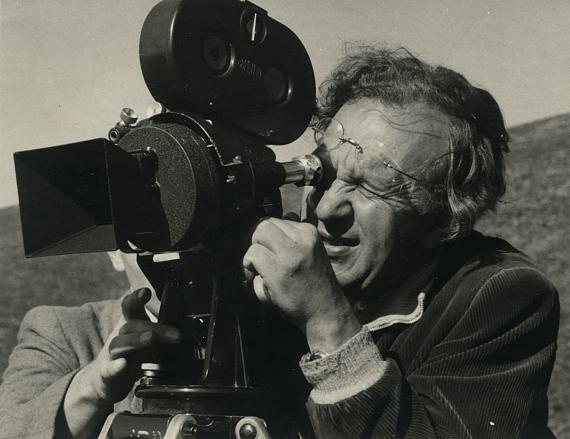
Alfred Ehrhardt bei Dreharbeiten in Schweden, 1950
8,9 x 13,9 cm, Silbergelatineabzug
© Alfred Ehrhardt Stiftung
Alfred Ehrhardt »
Films Like Never Before / Filme wie noch nie
Bauhaus Artist and Filmmaker
Exhibition: 18 Apr – 5 Jul 2026
Sun 21 Jun

Alfred Ehrhardt Stiftung
Auguststr. 75
10117 Berlin
+49 (0)30-20095333
info@aestiftung.de
www.aestiftung.de
Tue-Sun 11-18
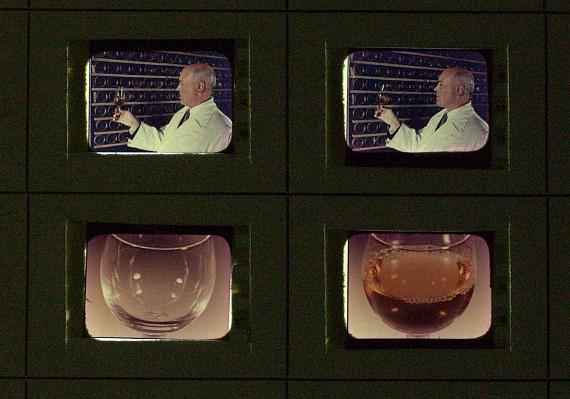
Szenenabfolge mit originalen 35mm-Filmkadern des fertig montierten Films "Portwein", 1960
© Alfred Ehrhardt Stiftung
"Films Like Never Before"
Alfred Ehrhardt – Bauhaus Artist and Filmmaker
Exhibition: 18 April – 5 July, 2026
Opening: Friday, 17 April, 7–9pm
Curated by Stefanie Odenthal, Christiane Stahl & Thomas Tode
For the very first time, Alfred Ehrhardt’s film work is the focus of an exhibition. The photographer,
documentary filmmaker, and Bauhaus-trained artist created more than sixty films—an oeuvre that
has long been overshadowed by his photographic work. Now, the Alfred Ehrhardt Stiftung bring his
films to the fore, offering a fresh aesthetic and historical perspective on one of the most prolific
German cultural filmmakers of the twentieth century.
A selection of twenty key short and feature-length films will be presented across ten screens in two
program phases: ten films during the first five weeks of the exhibition, followed by ten further works
in the second half. The selection includes nature studies, films on art and cultural history, as well
as productions from the Nazi era that have rarely been shown to date. The exhibition features
Ehrhardt’s so-called “shell films” devoted to snails, mussels, and corals; his investigations of nature
as a master of form, including studies of the tidal flats near Neuwerk, volcanic landscapes in
Iceland, and ice formations off the coast of Greenland; as well as films on art and artists, among
them works on Ernst Barlach, documenta II, and African masks.
Problematic aspects are not glossed over. With Urkräfte am Werk (Germany 1937/39), Ehrhardt’s
debut film rediscovered in 2024, and the propaganda film Flanderns germanisches Gesicht (Germany
1941), his cinematic practice is examined within the historical context of its time.
Presenting multiple films in parallel makes it possible—for the first time—to gain a comprehensive
overview of Ehrhardt’s central motifs, methods, and obsessions. Spirals, islands, serial structures,
and a fascination with life processes as visualized through media emerge with particular clarity.
From at least the early 1950s onward, Ehrhardt explicitly drew on his Bauhaus training, employing
bona fide cinematic techniques such as time-lapse, slow motion, and extreme macro photography.
It is only on this basis that the material and technical foundation of his film work become fully
apparent. Since 2019, fourteen films have been newly digitized and restored, eight of them with the
support of the German Film Heritage Funding Program of the German Federal Film Board (FFA).
In parallel, extensive research has been conducted in external archives over the past several years,
and for the first time all film-related materials in the Alfred Ehrhardt Stiftung archive have been
digitized, analyzed, and systematically cataloged.
The exhibition is accompanied by a comprehensive illustrated volume,
Alfred Ehrhardt—Film, which documents his cinematic work in detail for
the first time. Within the exhibition, archival materials presented in
vitrines and display windows—including film scores created during the
editing process, production photographs, and musical notations by
composers such as Oskar Sala—offer insights into Ehrhardt’s working
methods and his distinctive inventive spirit. Film posters and awards
testify to the lasting recognition and esteem in which this highly
acclaimed German Film Award recipient is held today.
The Alfred Ehrhardt Stiftung preserves one of the best-documented
estates of a German cultural filmmaker of the post-war period. The
exhibition presents Alfred Ehrhardt as a filmmaker in a new light, with
a breadth and depth that has never been seen before. Films like never
before!
Catalogue
Accompanying the exhibition is the publication "Alfred Ehrhardt—Film" (German/English, edited by Christiane Stahl and Stefanie Odenthal for the Alfred Ehrhardt Stiftung, with texts by Thomas Tode, 288 pages,
Dölling und Galitz Verlag, Hamburg 2026).
Accompanying events
Thursday, April 30, 2026, 7 pm
»Music for Alfred Ehrhardt’s Iceland films: Georg Vollerthun and Oskar Sala«, film lecture by Florian Schuck, musicologist
Thursday, May 28, 2026, 7 pm
»New research findings on Alfred Ehrhardt’s films«, film lecture by Thomas Tode, publicist, film scholar, and curator
Thursday, June 11, 2026, 7 pm
»Portugal 1951: A country between modernization and tradition« film and slide presentation by Dr. Christian von Oppen, architect and urban researcher
Thursday, June 18, 2026, 7 pm
Guided tour of the exhibition with film scholar Thomas Tode and Dr. Christiane Stahl, director of the Alfred Ehrhardt Foundation
Sunday, July 5, 2026, 4 pm
Guided tour of the exhibition with film scholar Thomas Tode and Dr. Christiane Stahl, director of the Alfred Ehrhardt Foundation, followed by a closing reception
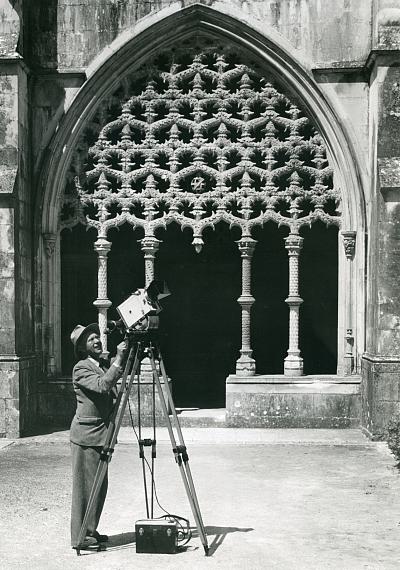
Alfred Ehrhardt filmt den Kreuzgang in Batalha, Portugal, 1952
24,3 x 17,2 cm, Silbergelatineabzug
© Alfred Ehrhardt Stiftung
"Filme wie noch nie"
Alfred Ehrhardt – Bauhäusler und Filmemacher
Ausstellung: 18. April bis 5. Juli 2026
Eröffnung: Freitag, 17. April, 19-21 Uhr
Kuratiert von Stefanie Odenthal, Christiane Stahl & Thomas Tode
Zum allerersten Mal rückt die Filmarbeit von Alfred Ehrhardt in den Fokus einer Ausstellung. Mehr
als 60 Filme hat der Fotograf, Dokumentarfilmer und Bauhaus-Schüler realisiert, ein OEuvre, das
bislang im Schatten seiner fotografischen Arbeiten stand. Nun stellt die Stiftung Alfred Ehrhardts
Filme ins Zentrum und macht einen der produktivsten deutschen Kulturfilmer des 20. Jahrhunderts
neu lesbar, ästhetisch wie historisch.
Auf zehn Bildschirmen entfaltet sich eine Auswahl von 20 zentralen Kurz- und Langfilmen, die in
zwei Programmphasen präsentiert wird: zehn Filme in den ersten fünf Wochen, zehn weitere in der
zweiten Hälfte der Ausstellung. Darunter finden sich Naturstudien, Filme über Kunst und kulturhistorische
Arbeiten, aber auch bislang kaum gezeigte Produktionen aus der NS-Zeit. Zu sehen sind
u.a. Ehrhardts sogenannte Gehäusefilme über Schnecken, Muscheln und Korallen, seine Studien
zur Natur als Formmeisterin, etwa zu Watt-Strukturen bei Neuwerk, Vulkanlandschaften auf Island
oder Eisskulpturen vor Grönland, ebenso wie Filme über Kunst und Künstler, darunter Arbeiten zu
Ernst Barlach, zur documenta II oder zu afrikanischen Masken.
Nicht ausgespart bleiben die problematischen Kapitel. Mit "Urkräfte am Werk" (D 1937/39), seinem
2024 wiederentdeckten Erstlingsfilm, und dem Propagandafilm "Flanderns germanisches Gesicht"
(D 1941), wird Ehrhardts filmisches Schaffen auch im historischen Kontext seiner Zeit verhandelt.
Die parallele Präsentation mehrerer Filme ermöglicht erstmals eine Zusammenschau zentraler
Motive, Methoden und Obsessionen. Spiralen, Inseln, serielle Strukturen und das Interesse an medial
sichtbar gemachten Lebensprozessen treten deutlich hervor. Spätestens seit den frühen 1950er
Jahren knüpft Ehrhardt dabei bewusst an seine Ausbildung am Bauhaus an und nutzt genuin filmische
Mittel wie Zeitraffer, Zeitlupe und extreme Makroaufnahmen. Erst auf dieser Basis wird die
materielle und technische Grundlage seiner filmischen Arbeit sichtbar. 14 Filme wurden seit 2019
neu digitalisiert und restauriert, acht davon mithilfe des Förderprogramms Deutsches Filmerbe der
Filmförderanstalt FFA. Parallel dazu wurden in den vergangenen Jahren umfassende Recherchen
in externen Archiven unternommen sowie sämtliche filmbezogenen Materialien des Archivs der
Alfred Ehrhardt Stiftung digitalisiert, ausgewertet und erstmals systematisch erschlossen.
Begleitend erscheint der umfangreiche Bildband "Alfred Ehrhardt – Film", der das filmische Werk erstmals ausführlich dokumentiert. In der Ausstellung geben Archivmaterialien in Vitrinen und Schaufenstern,
darunter Filmpartituren aus dem Schnittprozess, Arbeitsfotografien, Musiknotizen unter anderem von Oskar Sala, Einblick in Ehrhardts Arbeitsweise und seinen ausgeprägten Erfindergeist. Filmplakate und Auszeichnungen dokumentieren zugleich die zeitgenössische Anerkennung des vielfach geehrten "Bundesfilmpreisträgers vom Dienst".
Die Alfred Ehrhardt Stiftung bewahrt heute einen der am besten dokumentierten
Nachlässe eines deutschen Kulturfilmers der Nachkriegszeit. Die Ausstellung zeigt Alfred Ehrhardt als Filmemacher neu, in einer Breite und Tiefe, wie sie bislang nicht zu sehen war. Filme wie noch
nie!
Katalog
Anlässlich der Ausstellung erscheint die Publikation "Alfred Ehrhardt – Film" (Dt./Engl., hrsg. von Christiane Stahl und Stefanie Odenthal für die Alfred Ehrhardt Stiftung, Texte von Thomas Tode, 288 Seiten, Verlag Dölling und Galitz, Hamburg 2026)
Begleitende Veranstaltungen
Donnerstag, 30. April 2026, 19 Uhr
»Musik zu Alfred Ehrhardts Island-Filmen: Georg Vollerthun und Oskar Sala«
Filmvortrag von Florian Schuck, Musikwissenschaftler
Donnerstag, 28. Mai 2026, 19 Uhr
»Neue Recherche-Erkenntnisse zu Alfred Ehrhardts Filmen«
Filmvortag von Thomas Tode, Publizist, Filmwissenschaftler und Kurator
Donnerstag, 11. Juni 2026, 19 Uhr
»Portugal 1951: Ein Land zwischen Modernisierung und traditioneller Prägung«
Film- und Lichtbildervortrag von Christian von Oppen
Donnerstag, 18. Juni 2026, 18 Uhr
Führung durch die Ausstellung mit dem Filmwissenschaftler Thomas Tode und
Dr. Christiane Stahl, Direktorin der Alfred Ehrhardt Stiftung
Sonntag, 5. Juli 2026, 16 Uhr
Führung durch die Ausstellung mit dem Filmwissenschaftler Thomas Tode und
Dr. Christiane Stahl, Direktorin der Alfred Ehrhardt Stiftung, mit anschließender Finissage
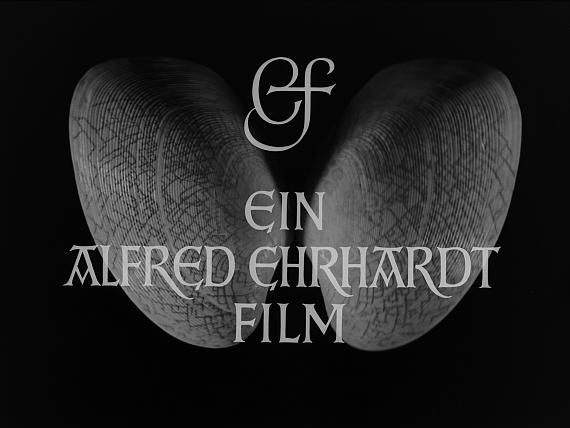
Filmstill aus dem Film "Tanz der Muscheln", 1955/59
© Alfred Ehrhardt Stiftung
[Herkunftsnachweis: Bundesarchiv, Tanz der Muscheln, Film 8889]
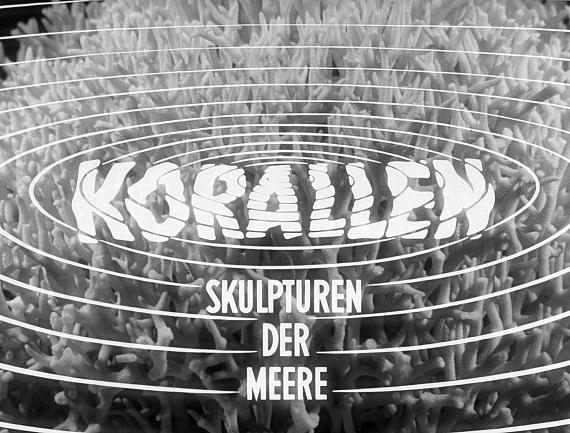
Filmstill aus dem Film "Korallen – Skulpturen der Meere", 1964
© Alfred Ehrhardt Stiftung
[Herkunftsnachweis: Bundesarchiv, Bundearchiv, Korallen – Skulpturen der Meere, Film 8887]