
Ceal Floyer »
Unfinished
Exhibition: 4 May – 22 Nov 2026
Wed 6 May

Palazzo Diedo – Berggruen Art & Culture
Cannaregio 2386
30121 Venezia
+39 041-
info@berggruenarts.org
www.berggruenarts.org
Thu-Sun 10-19
Unfinished - Ceal Floyer
curated by Ann Gallagher and Jonathan Watkins
Palazzo Diedo - Berggruen Arts & Culture Venice
May, 4 - November 22, 2026
Berggruen Arts & Culture will present an exhibition of works by the acclaimed British artist Ceal Floyer, who died in December 2025.
Comprising video, photography, sound, readymades and sculptural pieces, Floyer’s work often employs humour derived from shifting points of view, puns, double-takes and an idiosyncratic reordering of everyday phenomena. It conveys simultaneously the vital possibility of creativity in any situation and a hint of absurdity.
Ceal Floyer was one of the foremost conceptual artists of her generation, renowned for her concise humour and profoundly understated visual language. Her works are brilliantly inventive, full of razor-sharp intelligence, dry wit, and visual acuity.
Born in Karachi in 1968, Floyer spent some time as a child in Sydney and Rabat, before her family settled in England. She studied at Goldsmiths College, London during 1991-94, heady years for the Young British Artists (YBAs) and, before she graduated, she was already being noticed by well-placed critics and curators.
She was included in the seminal group exhibition
General Release
, organised by the British Council for the 1995 Venice Biennale. On this occasion she exhibited
Unfinished
(1995), a closeup looped video projection of someone rolling, or “twiddling”, their thumbs. The exhibition takes its title from
Unfinished
, bringing the work back to Venice after more than thirty years.
The first work in the exhibition
’Til I Get It Right
(2005) is a sound piece that plays a line from Tammy Wynette’s famous country song, “I’ll just keep on … ‘til I get it right”, with the words “falling in love” edited out, played in a repetitive loop. Other highlights include
Bucket
(1999), in which a CD player emits the sound of a water drop falling every few seconds.
Again and Again
(2012) results from Floyer handwriting the word “Again” over and over, on top of itself, to become illegible. In a complementary work,
Ink on Paper
(2010), involved the process of felt tip pens fixed upright on sheets of blotting paper until their ink drained out to make a series of stains, the range of colours determined by the number of pens in a bought set. As Floyer observed, “the result is something actually quite beautiful (which at first I found slightly alarming) and for me this is OK because it manages to stay faithful to the conceptual origins of the work”.
Such colour is unusual for Floyer, an artist perhaps most famous for her
Monochrome Till Receipt (White)
(1999). This work, listing white items bought from a supermarket, conflates everyday experience in the real world with the idea of modernist abstraction taken to its extreme. Similarly, the white video screen of
Blind
(1997) appears to be a homage to structural-materialist filmmaking of the 1960s and 70s, but then reveals itself to be footage of a roller blind moving against a window.
Blind
involves the kind of word-play that occurs throughout Floyer’s work.
Half Empty
and
Half Full
(1999), two identical photographs of a glass half-filled with water, refers to the expression that defines optimism and pessimism. While
Light Switch
(1992), the earliest work in the exhibition, projects the actual-size image of a light switch directly onto a wall. One of her most recent and touching works,
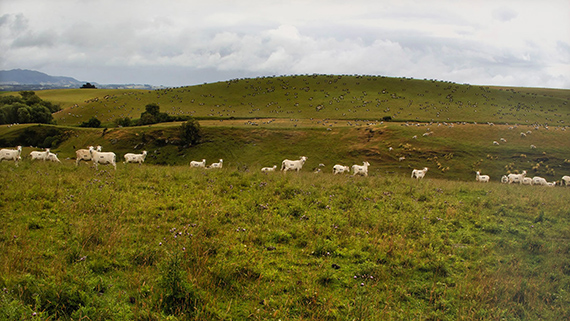
644
, (2025), a colour photograph, depicts sheep grazing in a hilly landscape. A number from 1 to 644, in a simple font, is superimposed on each, reminding us of the counting we were encouraged to do as children slipping into sleep.
The exhibition is supported by Esther Schipper and Lisson Gallery.