
Tanit Plana »
Disfuncionarias
Exhibition: 11 Jun – 25 Oct 2026
Museo Cerralbo
Ventura Rodríguez, 17
28008 Madrid
+34 91-5 473 646
museo.cerralbo@mecd.es
www.museocerralbo.mcu.es
Tue-Sat 9:30-15, Thu 17-20, Sun 10-15
Tanit Plana is part of a generation that has renewed Spanish photography, expanding it toward installation-based practices.
She questions systems of representation, connecting image, politics, and the body through a critical perspective.
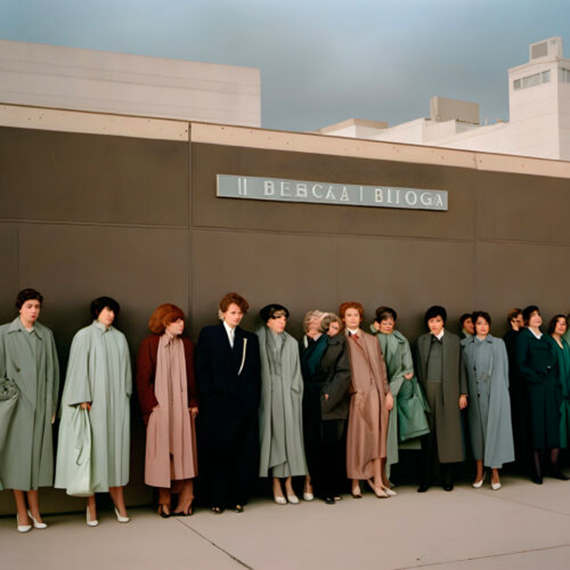
Disfuncionarias is a site-specific installation that proposes a sensitive and critical approach to the bureaucratic body: the body that classifies, orders, inventories, and stores everything that can be regulated, recorded, or preserved. Through large-scale fabrics that traverse the exhibition space, the installation of Tanit Plana (Barcelona, 1975) explores the tension between the institutional logics that sustain the museum and the living reality of collections, which always exceed any system of classification.
In this context, artificial intelligence appears as a contemporary extension of this administrative logic. It not only expands the field of the visible, but also introduces an organizational principle that translates the world into data, patterns, and mathematical relations. Within this rationality, images, objects, and documents become potentially indexable and processable, extending the archive’s historical aspiration: to render the world legible, manageable, and calculable.
Printed on large fabrics, the images undergo a transformation of their rigid form. What initially appeared as a stable body—ordered figures, closed compositions—now unfolds into flexible surfaces that fold, undulate, and spill into the surrounding space. The fabric introduces a material dimension that alters the stability of the image: what is displayed deforms, shifts, and loses its fixed contour, acquiring an almost organic condition.
Covered volumes emerge in the space, evoking the wrapped bundle: ambiguous presences that point to something that is there without being fully revealed. This gesture introduces a latent dimension of care, a remainder that persists without fully integrating into the symbolic order.
Disfuncionarias situates itself at this threshold: between the mathematical logic that organizes and the sensitive matter that insists on exceeding it. Between archive and mystery, the fragile balance that allows a museum to exist becomes visible.