
2022
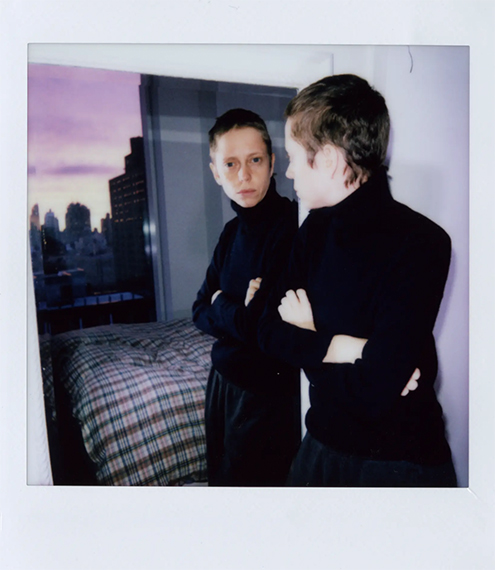
Unique Fujifilm Instax Square print
3⅖″h x 2⅘″w (9 x 7cm)
© Marie Tomanova
Marie Tomanova »
Three Empty Weeks in July
Exhibition: 12 Jun – 11 Jul 2026
Fri 12 Jun
Harkawik is pleased to announce our first exhibition with Czech-born, New York-based artist Marie Tomanova. On January 1, 2022, as most of us were contemplating the year ahead, Tomanova began a project that would test her relationship to the constructed image and her capacity for unrelenting self-scrutiny, and yield some of the most haunting, complicated, enigmatic images of recent memory. Three Empty Weeks in July is what emerged, so named for the weeks when she was inactive, a stretch that was left “open” to reference the halting and incomplete nature of the documentary tradition.
A close reader of these pictures can identify certain themes. Signifiers of truth and place are rendered illegible or indistinct. Tomanova often takes to a crouching or fetal position, as if the camera is an intruder, and the familiar safety of this pose an escape. She employs material often used to signify purity, or else suggest a connection between the female figure and prevailing views of natural beauty, in ways that problematize that imperaive. Fruit, flowers, and foliage make many appearances, often obscuring the genitals in an almost biblical sense, or else used to suggest the erotic in other ways. Tomanova’s equipment of choice is a Fujifilm Instax Square SQ6, chosen for its ability to double-expose its small format instant film, and she employs this to great effect, superimposing her body on landscapes, buildings, itself; light and shadow become a character and a volumetric presence in the picture plane. The artist is clearly a student of the history of portraiture, and artists like Francesca Woodman, Nan Goldin, Melissa Shook, Friedl Kubelka, and Yurie Nagashima can be felt.
It is difficult to look at photos of such an intimate nature and not feel a kind of closeness with their subject. Yet this is, in more ways than one, a lie. For one thing, the act of making representational art is always self-conscious. Despite the impromptu and improvisational character of many of these images, we know the artist set out to perform them as a daily ritual—a premeditated, constructed gesture (sometimes painfully so) that negates any immediate claim to verité or fidelity to a particular series of persons or events. Furthermore, were these images an earnest attempt to lay bare the self, what can we really learn about a person by observing them daily through static images, even if they might be personal, at times manic, ebullient, solemn, inward, brooding, histrionic, earnest, raw? They’re still contextless, unrelenting pictures of life. Rather than the truth they may show us, it is itself the closeness we feel to Tomanova, and the peculiar lie of it, that is at issue here. We are implicated by her, drawn into a proposition that continues to shift and unfold the deeper we go. We are complicit in something unknowable and strange, that may not ultimately have much to offer about Tomanova herself, but that speaks volumes about our cultural condition.
In the short history of conceptual art, certain turns are evident, and they intersect with the broad trajectory of Tomanova’s practice in specific ways. For one, we see the legacy of the artwork as a set of instructions. Three Empty Weeks in July proposes a specific kind of engagement with the photographic image that has a distinct shape and set of parameters. We see Tomanova depicted alongside a variety of canonical images, photobooks, and occasionally her own work. In a basic sense, the artist engages the most primal tradition of representational art by reaching for the person most readily-available to every artist—themself. The act of depicting the moment of creation, the picture-within-picture, is ancient and storied. Standing among this array of faces peering at the viewer, it is a more recent tradition that’s evident: conceptual art’s dialogue between a set of instructions and its own inevitable disintegration, and within it, Tomanova’s stunning achievement.
—Peter Harkawik