
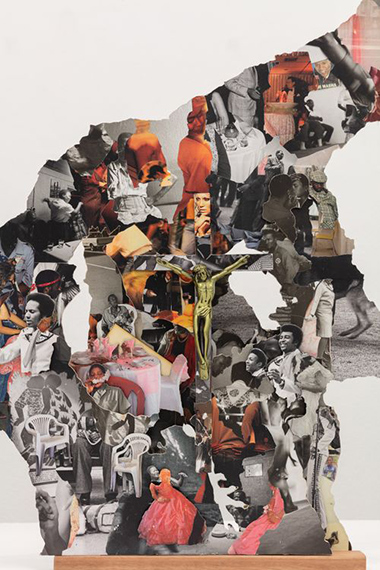
collage, mirror and found objects on wood
Courtesy of the artist and Stevenson, Cape Town / Amsterdam.
Photo: Mario Todeschini.
Thato Toeba »
ANYONE CAN BE LUCIFER
Exhibition: 6 Jul – 4 Oct 2026
Salle Henri Comte
28 Rue de l'Hôtel de ville
13200 Arles
Les Rencontres de la Photographie
34, rue du Docteur Fanton
13200 Arles
+33 (0)4-90967606
Collage and photomontage have long operated as world building strategies. The early Modernists understood it’s potential when they applied cut and paste techniques to Dada, Surrealist and Constructivist practices, creating radical counter‑realities which subverted dominant world views. Their works, pieced together with appropriated or found material, exploited photography’s capacity for abstraction, manipulation and provocation, providing an effective tool with which to critique the growing fascist ideology of the period.
A century later, Thato Toeba continues this legacy. Toeba is a disrupter, perhaps even a contemporary Dadaist. Toeba’s work reveals flawed ideologies and provides an alternative to colonial and imperial histories. An artist, lawyer and social science researcher, Toeba approaches collage with a deep sensitivity informed by their birthplace in Lesotho, which, though encircled by South Africa, existed as a British protectorate rather than a fully colonised territory from 1868 until independence in 1966.
Toeba’s practice uses collage and archival material to expose the legacy of Empire and colonialism, particularly in reference to South African histories. Their material choices reflect the scarcity of accessible regional archives. With much of Africa’s visual history held in European institutions—and with the continent’s identity mediated through white photographers—Toeba frequently turns to found images and secondary sources. This strategy, though seemingly at odds with their legal background, resonates with Modernist precedents of appropriation and authorship.
In intricately constructed three dimensional forms, Toeba combines personal photographs with fragments from newspapers and magazines, held within complex layered structures of mirrors, glass, board and wood. These fractured ‘conversations’ between images abstract our perspective, revealing and concealing in equal measure. Negative space signals erasure, reflecting on absent histories, power structures and knowledge hierarchies. Toeba’s composites offer an alternative vantage to what was never there but perhaps should have been.
Fiona Rogers