
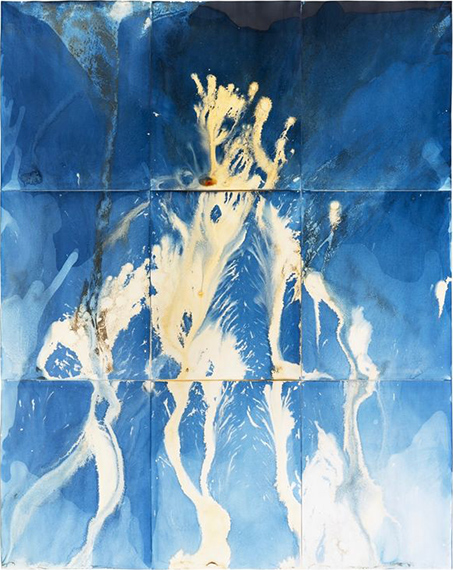
Adaptive Radiation #1 (Hanford Reach, Washington, USA, 5.23.2025,
River Water, Reference Woman, Reducing Agent), May 23, 2025,
series State Shift, 2024–2026, unique dynamic cyanotype
Courtesy of the artist.
Meghann Riepenhoff »
UPWELLING
Exhibition: 6 Jul – 4 Oct 2026
Cloître Saint-Trophime
20 Rue du Cloître
13200 Arles

Les Rencontres de la Photographie
34, rue du Docteur Fanton
13200 Arles
+33 (0)4-90967606
My earliest memories are from the shore, where water and land met and moved each other. The sea seemed beautiful and dangerous, vast, and yet intimately connected to my very being. Before I knew I was made of water, water seemed to know me. I now work collaboratively with the environment, making dynamic cameraless cyanotypes through direct contact with the elements. Each piece is a fingerprint of time, place, wildness, and conditions.
This exhibition, Upwelling, considers the complex nature of our relationships to the landscape, the sublime, time, and impermanence. An Upwelling is both an essential oceanic process that renews ecosystems, and a term used to describe a growing emotional or political momentum.
The exhibition includes pieces from five series: Waters of the Americas works with bodies of water impacted by human interventions; Ecotone collaborates with precipitation in both built and unbuilt topographies; Chronographs are exhibition-specific books that expose one page per day of the show; Adaptive Radiation is made with ecosystems most impacted by the United States’ nuclear legacy; State Shift includes work I made during the two years my family was displaced after a climate event destroyed our home.
The work in Upwelling examines the profound ways humans are shaping our collective environment as our environment shapes us. Sites include a former plutonium mine that is now the most contaminated area in the US; Utah’s Great Salt Lake when its water levels were the lowest in recorded history; and a river in Sun Valley, Idaho that was contaminated by the mining of the same silver that has been an essential part of photography for over a century.
Several pieces also include fungi ink, resulting in prints that have regenerative, bioremediative properties. Even as water, our most essential resource, warns us that our current path is unsustainable, the prints become gestures of connection, hope, and repair.
Meghann Riepenhoff