
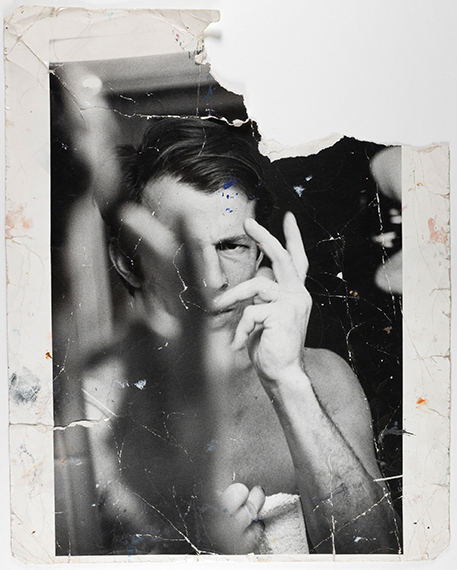
Self-Portrait Taken at The Bristol Hotel, Paddington, London, 1975
Used as a reference print for Francis Bacon's portraits of Peter Beard
Vintage silver gelatin print, the verso covered in paint residue
From the floor of Francis Bacon's studio
38.3 x 30.2 cm
© The Estate of Peter Beard
Courtesy of Michael Hoppen Gallery
Independent 20th Century
Anonymous » Peter Beard » Bruce Bernard » John Deakin » Eadweard J. Muybridge » Jacques Saraben » & others
Fair: 24 Sep – 27 Sep 2026
Thu 24 Sep 11:00
Sotheby’s New York - The Breuer
945 Madison Avenue
NY 10021 New York

Michael Hoppen Gallery
10 Portland Road
W11 4LA London
+44 (0)20-73523649
gallery@michaelhoppengallery.com
www.michaelhoppengallery.com
Mon-Fri 10-18
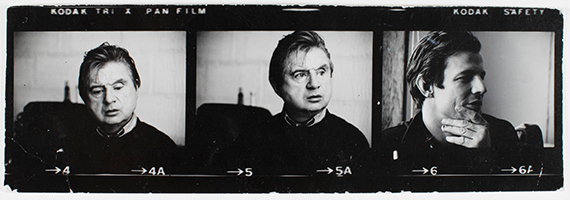
Francis Bacon and Peter Beard during the 'Dead Elephant Interviews', London, 1972
Various annotations in pencil and ink verso by Francis Bacon
Unique vintage gelatin silver contact print from lost negatives, from the
floor of Francis Bacon's studio
6 x 18 cm
© The Estate of Peter Beard
Courtesy of Michael Hoppen Gallery
Paper from the floor of Francis Bacon’s Studio
Independent 20th C, New York
September 24th-27th
A private collection of photographs and studio material from the world of Francis Bacon.
A remarkable private collection of photographs and photographic material associated with Francis Bacon is to be exhibited publicly for the first time, revealing an intimate and largely unseen aspect of the artist’s working life.
Collected over more than two decades by dealer and collector Michael Hoppen, the unique and rare collection brings together original photographs, contact sheets, collages, annotated prints, and source material that illuminate the working processes and intimate world of one of the twentieth century’s greatest painters. Much of the material originated from Bacon’s 7 Reece Mews studio in South Kensington, where he lived and worked from 1961 until his death in 1992. The studio, famous for its layers of photographs, books, newspapers, discarded canvases and painting materials, was not simply a backdrop to Bacon’s practice but an active part of it: a visual environment in which images accumulated, collided and acquired new possibilities.
At the heart of the exhibition is the relationship between photography and painting. Bacon rarely worked directly from life, instead turning repeatedly to photographs as a means of stimulating, distorting and transforming reality. The material gathered around him was extraordinarily diverse: photographs of friends and acquaintances, newspaper cuttings, reproductions, film stills, medical imagery and studies of the human body. Rather than imposing a hierarchy upon these sources, Bacon absorbed them into what might be described as a vast private reservoir of images.
Among the most significant material in the exhibition are photographs by John Deakin, whose uncompromising portraits of Bacon and those around him became deeply embedded in the artist’s visual world. Deakin’s photographs were not merely portraits in the conventional sense; their intensity and physical directness offered Bacon a way of apprehending the human figure that could be radically reimagined in paint. Photographs by Deakin are also documented among the surviving material from Reece Mews itself.
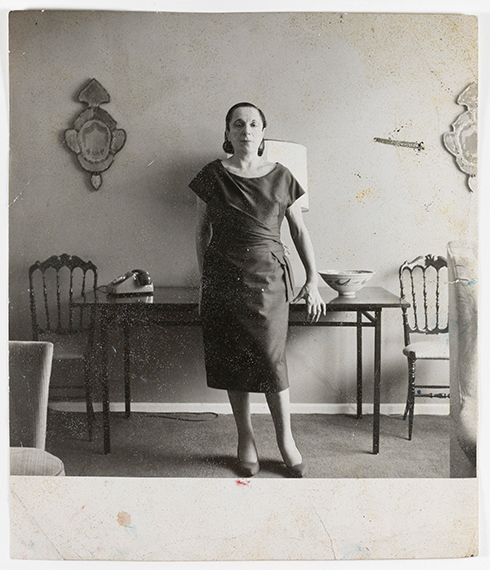
Muriel Belcher, c. 1950s
Vintage silver gelatin print
Paper size: 35.6 x 27.9 cm
(29602-JOD)
© The John Deakin Archive
Courtesy of Michael Hoppen Gallery
Bruce Bernard - ….’Deakin could certainly seem a monster, but, while he inspired dread and loathing in some (including No l Coward, Cecil Beaton and George Melly), he could also provoke affection in all kinds of people. More importantly, he was surely one of the best portrait photographers this century.
John Deakin …’Being fatally drawn to the human race, what I want to do when I photograph it is to make a revelation about it. So my sitters turn into victims. But I would like to add that it is only those with a demon, however small and of whatever kind, whose faces lend themselves to be victimised at all’…….
The exhibition also includes motion studies by Eadweard Muybridge, whose seminal sequential investigations of movement provided Bacon with an enduring source of imagery, alongside original enlarged contact sheets depicting two large anonymous wrestlers who were photographed for Bacon in New York in the 1970’s. Particularly revealing are those contact sheets that bear Bacon’s own directional marks and annotations. These interventions offer a rare glimpse of the moment at which a found photograph began to become something else: an image selected, examined, marked, fragmented and transformed within the imagination of the painter.
The collection further includes rare vintage Cibachrome photographs by Bruce Bernard, the distinguished picture editor, writer and photographer who was a close friend of Bacon and a champion of so many great visual artists including John Deakin. Bernard first met Bacon around 1948 and photographed him in his Reece Mews studio in 1984, producing some of the most intimate surviving images of the artist and his working environment.
Also included are works by Jacques Saraben, Michel Gini s,anonymous photographers. Many of these seemingly incidental images were preserved because they had entered Bacon’s intensely private visual world. Their survival is therefore significant not simply for what they depict, but for what their presence tells us about the artist’s way of looking and his unique working practice.
Some of the most revealing material in the collection is that relating to Bacon’s long and unusually intimate friendship with the American photographer, artist and writer Peter Beard.
The two first met in London in the mid-1960s; their friendship endured for more than two decades, sustained by frequent correspondence and an exchange of photographs, books, drawings and other visual material.Beard occasionally sent Bacon photographs of himself to use as source material, and Bacon subsequently painted Beard repeatedly, producing nine major portraits- for which source material is included here.
Bacon and Beard were, in effect, exchanging ways of seeing. Beard’s photographs entered Bacon’s “floor-p tage”—his extraordinary accumulation of images—while Bacon’s paintings, ideas and conversations fed back into Beard’s own visual imagination. Their friendship became a sustained dialogue in which photography, painting, collage, portraiture and the natural world continually overlapped.
The Beard photographs and letters in the collection acquire a significance beyond their association with a famous friendship. They belong to the visual ecology in which Bacon worked: images gathered, handled, juxtaposed and repeatedly reconsidered until their original meanings became unstable and new possibilities emerged. Their presence offers an unusually direct glimpse into the dialogue between two artists who, although working in profoundly different media and often on opposite sides of the Atlantic, shared an intense fascination with mortality, metamorphosis, the body and the precarious boundary between man and animal. The importance of such material has become increasingly apparent since the extraordinary archaeological reconstruction of Bacon’s Reece Mews studio at The Hugh Lane Gallery in Dublin.
This small exhibition offers a different, more intimate encounter with that same world. Rather than presenting photographs simply as documentary evidence of Bacon’s life, it proposes that they should be looked at as objects and images in their own right—charged remnants of the visual environment from which some of the most powerful paintings of the twentieth century emerged.
For the first time, these privately held extremely rare photographs and studio survivals allow the public to enter the extraordinary image-world that surrounded Francis Bacon: a world in which the accidental, the intimate, the scientific, the erotic and the everyday could coexist, collide and ultimately become painting.
A limited edition independent publication, Out of Chaos, with an essay by Robin Muir, featuring all images in the show, accompanies this show. All works are for sale.
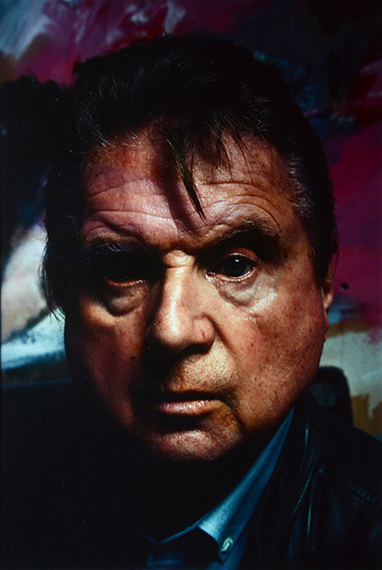
Francis Bacon, 1983
Artist wet stamp verso
Unique vintage cibachrome print
Image size 37.9 x 25.7 cm
© Estate of Bruce Bernard
Courtesy of Michael Hoppen Gallery
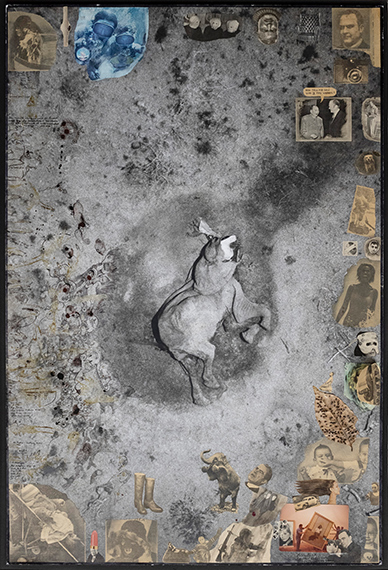
'Now Tell Me, Jelly, Who is this Warhol?', 1975
Signed in ink by the artist in lower right-hand corner
Unique vintage gelatin silver print with collage, various objects and
drawings by the photographer in ink and blood recto. Commissioned by
Andy Warhol for Interview Magazine
99.7 x 66.7 cm
© The Estate of Peter Beard
Courtesy of Michael Hoppen Gallery
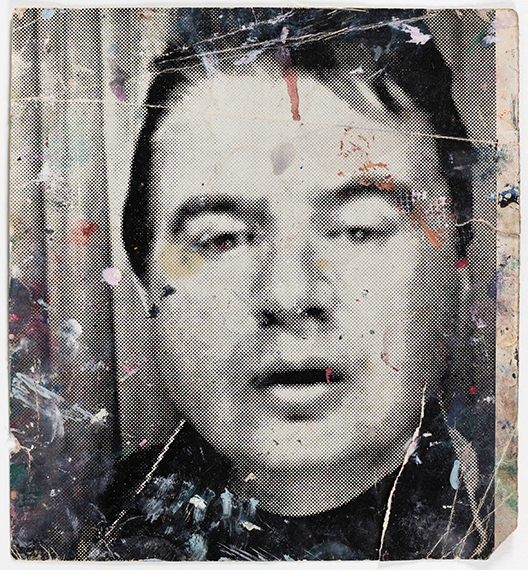
Half-tone Portrait of Francis Bacon, 1970s
Vintage gelatin silver print with ink and copious paint recto and verso
22.8 x 21 cm
Courtesy of Michael Hoppen Gallery