
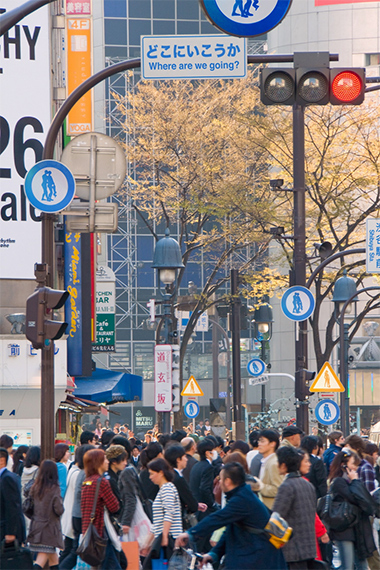
Colour print on canvas, 200 x 305.5 x 5 cm
© Owanto
Owanto »
The Lighthouse of Memory
- Go Nogé Mènè
Festival: 7 Jun – 22 Nov 2009
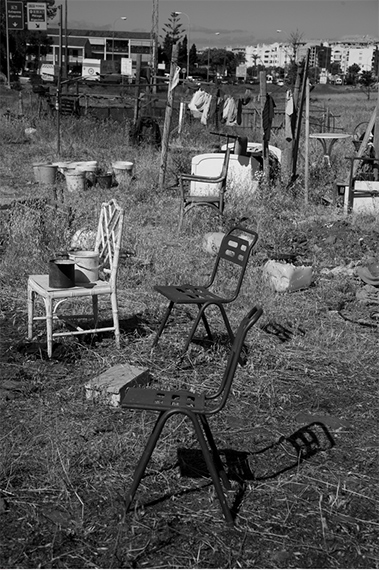
Black and white print on aluminium, 169 x 238 x 1 cm
© Owanto
Owanto was the chosen artist to represent the Republic of Gabon in what was the nation’s first participation at the Venice Biennale. The curator of the artistic project was Fernando Francés from Spain, Director of the Contemporary Art Centre of Málaga (CAC Málaga), who strictly complied with the official theme of the project proposed by that year’s general artistic director Daniel Birnbaum, focused to emphasize the creative processes. Parting from this notion, Owanto’s work used scrap elements and landscapes as raw materials for the design of the image and the gaze. Degraded spaces that reveal the footprints of an evolution but do not disclose the concrete identity of the territory. In this sense, the show presented a series of photos of these inexpressive but interrogatory places, which refer to the fate of the world and mankind. A road which may lead to chaos, to crisis and even to destruction, but which, if re-oriented from the experience of other cultures, can evolve towards the construction of a more committed world. In this way, the exhibition also mused on the ideas and lifestyles of the oriental and occidental worlds, of the Gabonese and the European. For this reason, Owanto presented “Let them Dream their Own Dreams”, the tree house, a piece built to scale that resembles an old rural Gabonese dwelling, like the one the artist’s grandmother used to live in. In the West, however, in its daily environment, it is only a ‘playhouse’ in which the artist recalls her childhood in Gabon, where the memory acts as the process and the material for the work. Projected in its interior is a sequence of photos that depict two Western girls who paint the walls of the cabañas, and concurrently turn this ‘playhouse’ into a studio, and as a result into a laboratory which the artist has interpreted as an installation where two opposite and contradictory, yet complementary, worlds come together. This tree house represents the stage of Owanto’s African past, but also the future of her daughter, who metallically plays out a dance which far from calling for rain or abundant game, calls for this changing world to evolve towards understanding, solidarity and peace; towards the construction of a common hearth where the family becomes the starting point for a global village.
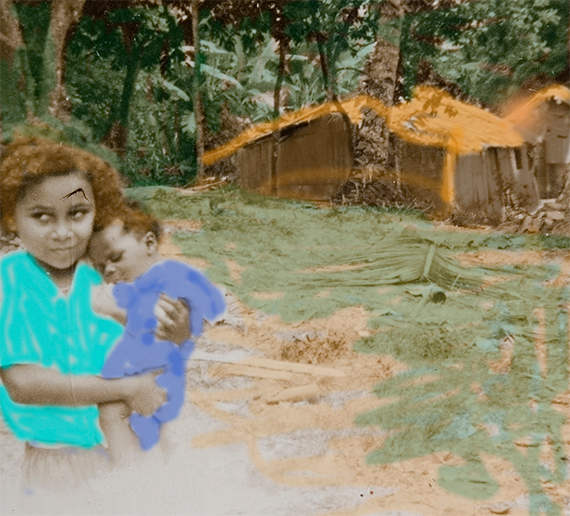
Projection 70 photos
© Owanto
Where are we going?
In the ‘Where are we going?’ series, I invite the viewer to reflect on the loss of family values and identity, in the cultural context of the Pop Art style of the 1950s. Using readymade, industrial and commercial objects, I have created a series of signposts and light-boxes, featuring my own symbols. I took the digitally processed silhouettes of the sculptures that I had created with my hands, and used them to supplant iconic images. In my work, ordinary people, as opposed to celebrities like Elvis and Marilyn, have become global icons. The pieces are designed to have the same effect as a ‘Stop’ sign on a road: to convey a warning in an instant, in this case that Love and Humanity must be observed. I have followed the same principle in the 2009 ‘Intervention with symbols’ series, in which I have incorporated my symbols into photographs taken all around the globe.
Where are the sheep?
In 2008, I created the ‘Where are the Sheep?’ series, a collection of photographs that tell the story of a field that I passed every day. Intrigued by this location, I began to frequent it, voyeuristically peering into a space that no-one was permitted to enter. The photographs speak of the beauty and desolation that coexisted in that place, and capture something of its life, its poignant story: a dilapidated house, a discarded chair, the remains of a bed; scavenging dogs, half-hidden signposts, absence and presence.
Let them dream their own dreams
"In 2001, we decided to spend our winters in the province of Málaga, Spain, and I began to work on the construction of the Tree House. The structure is at once a personal recollection of rural homes in Africa, and a western play space to be coloured by my children’s imaginations and feelings. I had dreamed of watching my children play in a tree house, like the one I had played in during my childhood in Africa. Over the years, shades of their personalities have manifested inside their respective cabanas, which reflect the constant evolution of life. Today, in Katya’s, there is a pink polka-dot wall and a cloud-filled blue sky, which reflect the emotions of a young girl; in Charles’s, the walls are stark black and white, contrasted only by the burnt orange ceiling. From the doorway of each cabana, one can peer into the other, like the architecture of the relationship between a sister and brother. Behind the tree house sits a climbing frame, which had once been lovingly painted by the little girl who used to live there. Now that the children have grown, and have stopped playing in the Tree House, it stands alone, season after season. Abandoned, it waits beside the climbing frame, for the poetry that is born of love and life and communication. Bringing the Tree House to Venice, and integrating it into the 16th Century cloister in Rialto, gave greater depth to the concept of memory. The projected photographs within the Tree House unite my voice with those of Agnorogoulé, Owanto’Bia and my daughter, Katya: four generations of women... our female bloodline. The photographs recreate the atmosphere of their times, and capture the spirit of the contemporary world".
The treehouse existed for 10 years in the artist’s garden before traveling to Venice to be exhibited at such a prestigious event as the Biennale where it become the star piece of the show. It is an installation piece which holds a slideshow projection and a video in its interior.
"The Lighthouse of Memory" consists of 70 photos that alternate between the past and present. "Freedom Dance" is a 77 second performance video that engages the viewer with the concept of Genetic Memory.