
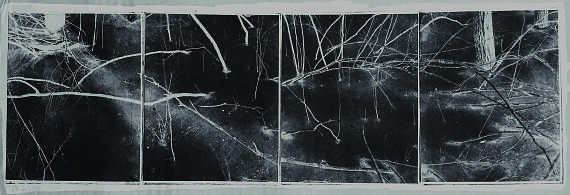
"Curtice Creek III", Kyoto, Japan 2024
Unique Talbotype paper negative on handmade gampi paper
Koichiro Kurita »
Journey of Light / Reise des Lichts
Exhibition: 7 Nov 2026 – 26 Feb 2027
Fri 6 Nov 17:00 - 20:00

Johanna Breede PHOTOKUNST
Fasanenstr. 69
10719 Berlin
+49 (0)30-88913590
photokunst@breede.de
www.johanna-breede.com
Tue-Fri 11-17, Sat 11-14
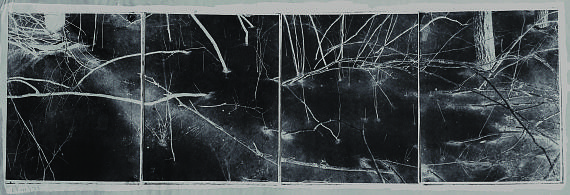
"Tangent II", Southold, NY. 2011
Calotype (Talbotype) paper negatives
Koichiro Kurita
"Journey of Light"
Exhibition: 7 November 2026 – 26 February 2027
Opening: Saturday, 7 November, 5-8pm
There is a photographic technique called the calotype. This concept of paper negatives and positives, introduced by Talbot in 1841, is considered the origin of photography. In my project titled "Beyond Spheres" (2010–2017), I began creating calotype (Talbotype) with the aim of visualizing the natural world as described by Henry D. Thoreau with his profound insights gained during his travels. Building on my experience creating negatives on handmade gampi paper for "Beyond Spheres," I am currently taking on the challenge of producing calotypes by building a large-format camera capable of handling 24×30-inch paper negatives.
I have been creating my works while walking through the forest, drawing inspiration from nature. When I encounter a subject, the first things I sense—light and then atmosphere, scent, etc,—stir my emotions through my perceptions, and I try to capture that scene. In my current project, the "Large-Format Calotype Project," the passage of time and invisible chemical reactions intertwine within the ever-changing light, slowly recording the scene as a tangible reality. The process by which memories, once locked away, resurface after this journey through light is both immeasurable potential and is also thrilling.
The word "photograph" literally means "picture of light"; we are able to see objects because sunlight strikes them and reflects off them in varying ways. While the amount of light reflected from each object differs—with black objects reflecting very little and white objects reflecting a great deal—light-sensitive materials are capable of capturing these subtle variations in light, and the technique of creating such images is known as photography.
In the calotype process, paper treated with photosensitive chemicals is placed in a camera and exposed to light, capturing subtle variations in light intensity. Next, the paper is removed from the camera and immersed in a plant-based solution. There, the intensity of the light received is converted into an image, creating a "picture of light." Areas where light was strongly reflected appear black, while areas with little reflection appear white, resulting in an inverted black-and-white image. This is called a "negative."
The journey of light continues.
In the early days of photography, various printing techniques were developed. To create a positive image, egg whites or gelatin were applied to make photographic paper; the negative was then placed on top, and light was shone through it once more. As the light passed through the negative, the image was inverted again, finally producing a photograph (positive) with the correct light and dark tones. Light has come a long way to reach this point.
From here on, we enter the realm of psychology: light now strikes this photograph, and it is through the reflection of that light that I—and all of you—can see it. Depending on differences in attributes such as gender, age, experience, and way of thinking, the visual appearance varies. That is the final destination of the "journey of light."
Koichiro Kurita: "Journey of Light" 2026
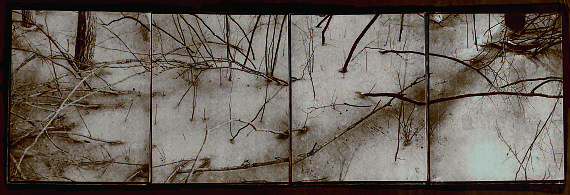
"Tangent II", Southold, NY. 2011
Albumen print from Talbotype paper negatives on gampi paper
Koichiro Kurita
"Reise des Lichts"
Ausstellung: 7. November 2026 bis 26. Februar 2027
Eröffnung: Samstag, 7. November, 17-20 Uhr
Es gibt eine fotografische Technik namens Kalotypie. Dieses 1841 von Talbot eingeführte Konzept von Papiernegativen und -positiven gilt als Ursprung der Fotografie. In meinem Projekt mit dem Titel "Beyond Spheres" (2010–2017) begann ich mit der Herstellung von Kalotypien (Talbotypien) mit dem Ziel, die Natur so darzustellen, wie sie Henry D. Thoreau mit seinen tiefgründigen Einsichten, die er auf seinen Reisen gewonnen hatte, beschrieb. Aufbauend auf meinen Erfahrungen bei der Herstellung von Negativen auf handgeschöpftem Gampi-Papier für "Beyond Spheres" stelle ich mich derzeit der Herausforderung, Kalotypien zu produzieren, indem ich eine Großformatkamera baue, die für 24×30-Zoll-Papiernegative ausgelegt ist.
Ich schaffe meine Werke bei Spaziergängen durch den Wald und lasse mich dabei von der Natur inspirieren. Wenn ich auf ein Motiv stoße, wecken die ersten Eindrücke – das Licht und dann die Atmosphäre, der Duft usw. – durch meine Wahrnehmung Emotionen in mir, und ich versuche, diese Szene festzuhalten. In meinem aktuellen Projekt, dem "Large-Format Calotype Project", verflechten sich der Lauf der Zeit und unsichtbare chemische Reaktionen mit dem sich ständig verändernden Licht und halten die Szene langsam als greifbare Realität fest. Der Prozess, durch den einst verschlossene Erinnerungen nach dieser Reise durch das Licht wieder an die Oberfläche treten, birgt unermessliches Potenzial und ist zugleich aufregend.
Das Wort "Fotografie" bedeutet wörtlich "Lichtbild"; wir können Objekte sehen, weil Sonnenlicht auf sie trifft und auf unterschiedliche Weise von ihnen reflektiert wird. Zwar unterscheidet sich die Menge des von jedem Objekt reflektierten Lichts – schwarze Objekte reflektieren nur sehr wenig, weiße Objekte hingegen sehr viel –, doch lichtempfindliche Materialien sind in der Lage, diese subtilen Lichtunterschiede festzuhalten, und die Technik zur Erzeugung solcher Bilder wird als Fotografie bezeichnet.
Beim Kalotypie-Verfahren wird mit lichtempfindlichen Chemikalien behandeltes Papier in eine Kamera eingelegt und belichtet, wodurch feine Unterschiede in der Lichtintensität erfasst werden. Anschließend wird das Papier aus der Kamera entnommen und in eine Lösung auf pflanzlicher Basis getaucht. Dort wird die Intensität des eingefangenen Lichts in ein Bild umgewandelt, wodurch ein "Lichtbild" entsteht. Bereiche, in denen das Licht stark reflektiert wurde, erscheinen schwarz, während Bereiche mit geringer Reflexion weiß erscheinen, was zu einem umgekehrten Schwarz-Weiß-Bild führt. Dies wird als "Negativ" bezeichnet.
Die Reise des Lichts geht weiter.
In den Anfängen der Fotografie wurden verschiedene Drucktechniken entwickelt. Um ein Positivbild zu erzeugen, wurden Eiweiß oder Gelatine zur Herstellung von Fotopapier verwendet; das Negativ wurde dann daraufgelegt und erneut mit Licht durchleuchtet. Beim Durchleuchten des Negativs wurde das Bild erneut umgekehrt, wodurch schließlich ein Foto (Positiv) mit den richtigen Hell- und Dunkeltönen entstand. Das Licht hat einen langen Weg zurückgelegt, um diesen Punkt zu erreichen.
Von hier an betreten wir das Reich der Psychologie: Licht fällt nun auf dieses Foto, und durch die Reflexion dieses Lichts kann ich – und ihr alle – es sehen. Je nach Unterschieden in Merkmalen wie Geschlecht, Alter, Erfahrung und Denkweise variiert die visuelle Wahrnehmung. Das ist das endgültige Ziel der "Reise des Lichts".
Koichiro Kurita, September 2026