
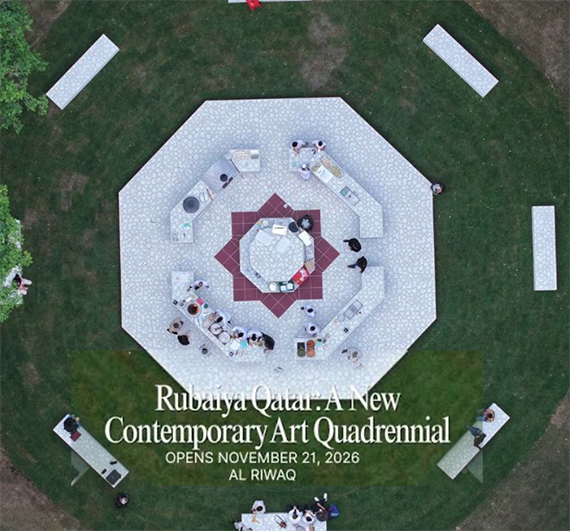
Rubaiya Qatar
Bani Abidi » Lawrence Abu Hamdan » Monira Al Qadiri » Farah Al Qasimi » Sophia Al-Maria » Sophia Al-Maria » Shaima Al-Tamimi » Kamal Aljafari » Nadia Belerique » Meriem Bennani » Mohamed Bourouissa » Liu Chuang » Olafur Eliasson » Alia Farid » Simone Fattal » CAO Fei » Nicholas Galanin » Shilpa Gupta » Taloi Havini » Sohrab Hura » Saodat Ismailova » Jitish Kallat » Naiza Khan » Ayoung Kim » Charles Lim Yi Yong » Basim Magdy » Diego Marcon » Naeem Mohaiemem » Manny Montelibano » Hira Nabi » Lydia Ourahmane » Pratchaya Phinthong » Tan Pin Pin » Khalil Rabah » Sheelasha Rajbhandari » Araya Rasdjarmrearnsook » Faisal Samra » Selma Selman » Hassan Sharif » Wael Shawky » Ahlam Shibli » Newsha Tavakolian » Rirkrit Tiravanija » HO Tzu Nyen » Munem Wasif » He Xiangyu » Ali Yahya » Ayman Zedani » & others
Festival: 21 Nov 2026 – 30 Apr 2027
Mathaf: Arab Museum of Modern Art
PO Box 2777 - Education City
Doha
+974 -4402 8855
Tu-Sun 11-18, Fri 15-20
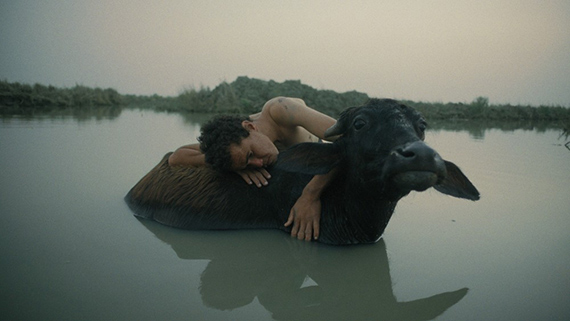
Beneath Which Rivers Flow, 2025.
Coloured digital video with sound, 16 min, 18 sec.
© Ali Yahya, Courtesy of the artist
Qatar Museums (QM) today unveiled the curatorial programme for the inaugural edition of Rubaiya Qatar, a new international visual arts quadrennial taking place from 21 November 2026 until 30 April 2027. Established under the leadership of Her Excellency Sheikha Al Mayassa bint Hamad bin Khalifa Al Thani, Chairperson, Qatar Museums, and presented by Qatar Museums and developed and organised under ALRIWAQ Arts + Architecture—Rubaiya Qatar’s institutional home and principal venue—the quadrennial aims to inspire and empower new generations of artists and thinkers, with the dynamic cultural hub of Qatar as their platform. Rubaiya Qatar will unfold across Doha, including at the newly renovated ALRIWAQ Arts + Architecture building, the Museum of Islamic Art (MIA), Katara QM Gallery, Mathaf: Arab Museum of Modern Art and public sites across the country.
The inaugural edition is centred on themes of global ecology; water’s social, political, economic, and cultural importance; and the maritime heritage that forged connections between Qatar and the world. It brings together exhibitions and public art installations featuring more than 120 regional and international artists representing more than 45 countries, with particular attention to artists from the Global Majority. The headline exhibition, Unruly Waters, curated by Tom Eccles, Ruba Katrib, Shabbir Hussain Mustafa, and Mark Rappolt, will present more than 30 new commissions by artists including Bani Abidi (Pakistan), Lawrence Abu Hamdan (Lebanon / UK), Sophia Al-Maria (Qatar), Majid Al-Remaihi (Qatar), Mohamed Bourouissa (France / Algeria), Ade Darmawan (Indonesia), Alia Farid (Puerto Rico / Kuwait), Ayoung Kim (South Korea), Charles Lim (Singapore), Naeem Mohaiemen (Bangladesh), Yuko Mohri (Japan), Oscar Murillo (Colombia), Priya Sen (India) and Marina Tabassum (Bangladesh).
The exhibition brings together a rich diversity of media and forms, spanning film, sculpture, painting, installation, food, performance, community activations, workshops and more. The works on show range from tenth-century ceramics to contemporary digital installations created with the help of AI, reflecting the breadth of artistic practices and perspectives brought together in Rubaiya Qatar.
Sheikha Reem Al Thani, Deputy CEO of ALRIWAQ Arts + Architecture, Public Art and Rubaiya Qatar said, “Rubaiya Qatar reflects our commitment to creating platforms that support artistic research, experimentation and production over the long term. As the institutional home of the quadrennial, ALRIWAQ Arts + Architecture brings together artists, curators, researchers and communities from Qatar and around the world to generate new knowledge, foster creative exchange and shape meaningful cultural dialogue. Through ambitious commissions, exhibitions, public art and public programmes, Rubaiya Qatar creates opportunities for lasting collaboration and artistic innovation while reinforcing Qatar's role as a place where ideas, perspectives and cultural practices converge. More than a platform for presenting art, Rubaiya Qatar is an investment in cultural production, international exchange and the relationships that will shape future generations of artists, thinkers and audiences.”
Sheikha Alanood Al Thani, Director of Rubaiya Qatar, said, “Cultural institutions in the SWANA region are no longer merely participating in the global discourse about contemporary art. They are setting its tone and shaping its future. The inauguration of Rubaiya Qatar marks a defining moment in this change, with Doha as the stage on which contemporary art from our region and beyond is presented to the world. Foregrounding non-Western perspectives, fostering ambitious new commissions and embedding deep ecological and historical research into its curatorial core, Rubaiya Qatar offers a fresh paradigm for international exhibitions of contemporary art.”
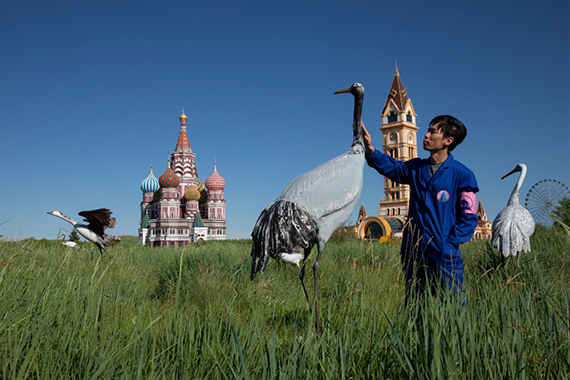
Unruly Waters (مياهٌ جَمُوح)
21 November 2026 – 30 April 2027
On view at ALRIWAQ Arts + Architecture, with additional presentations at the nearby Museum of Islamic Art (MIA) and in MIA Park, Unruly Waters takes its title from historian Sunil Amrith’s book of the same name, which explores the reciprocal relationship between water and humanity throughout history. Taking weather systems, ocean currents, and global trade routes as its guides, the exhibition examines how natural phenomena such as trade winds and monsoons have historically influenced cross-cultural interaction and continue to impact contemporary life.
Tom Eccles, Ruba Katrib, Shabbir Hussain Mustafa, and Mark Rappolt, the curators of Unruly Waters, said, “Establishing the framework for Rubaiya Qatar as a whole, the lead exhibition, Unruly Waters, is planetary in scope but highly specific in the geographies it explores. The artists it presents trace trade winds, monsoon rhythms, ocean currents, and digital communication networks—from ancient sea routes to the World Wide Web—to redefine ‘globalism’ through ecology and human movement, understanding it as a product of nature as much as of commerce. This specificity is true above all in the exhibition’s treatment of Qatar, with objects and artworks representing the nation’s place in past, present, and future global connections."
Centring Global Majority perspectives and the ancient trade networks of the Maritime Silk Road, Unruly Waters positions the Gulf not as an isolated region, but as a longstanding crossroads where ecological systems and artistic production intersect to offer new ways of understanding the past and imagining the future. This has never been more evident than in light of recent events in the region, which have once again underscored the Gulf’s central role in shaping the movement of people, resources, ideas, and power across the region and beyond.
Among the exhibition’s highlights are historic artefacts from the tenth-century Cirebon shipwreck, discovered off the coast of Java, Indonesia, and long held in the collections of Qatar Museums. Presented alongside contemporary commissions and works from the Museum of Islamic Art, these objects offer new perspectives on the extensive cultural and commercial exchange routes of the Maritime Silk Road. Contemporary commissions connect these histories to Qatar’s longstanding role as a global meeting point.
Our Common Currents (حِينَ نَنْسَابُ معًا)
22 November 2026 – 30 April 2027
Our Common Currents examines humanity’s enduring relationship with water, examining themes from cultural rituals and recreation to agriculture and industry. The exhibition will present works by 12 international artists, including four new commissions and loans from the future Art Mill Museum. Curated by Lina Patmali, Acting Head of Curatorial Affairs, Rubaiya Qatar, it will be presented at Katara QM Gallery.
As the basis of all survival and an essential element of cultural practices, recreational activities and agricultural and industrial uses, water is inextricably tied to human existence. Our Common Currents poses the question of how humans relate to water. Anchored in Qatar, where water is a defining element both in terms of its cultural and natural landscapes, the exhibition spans a range of different geographies.
Bodies of water—seas, lakes, rivers, icebergs—and natural phenomena including tides and aridity, alongside human interactions such as desalination, fishing and even swimming, are explored by 12 international artists and collectives that address their localities and personal reflections. Connecting these different perspectives, the exhibition’s narrative showcases how universal these experiences are and prompts us to rethink our everyday practices. Against the backdrop of global environmental, political and social crises, re-examining our relationship with water is essential to imagining sustainable and viable futures.
Lina Patmali, Curator of Our Common Currents, said, “In Our Common Currents, the artists featured explore how interconnected we are with the natural world. With a starting point being Qatar, the artworks presented have created connections with different geographical contexts. This exhibition not only responds to the pressing ecological matters explored in Unruly Waters but also builds on exhibitions and programs that already have been presented by Qatar Museums, reinforcing the commitment on environmental sustainability.”
Newly commissioned works include:
Taloi Havini's (Australia / Bougainville) site-specific sculptural installation and its courtyard garden, which was designed by conservation ecologist Dr. Aspa D. Chatziefthimiou using native desert and mangrove plants to evoke Qatar's land and shore
Latent Community's (Greece) environment exploring Qatar's diverse terrains—from rocky deserts and moving dunes to natural depressions and intertidal zones—for a meditation on the fragile ecosystems between desert and sea
Miguel Fernández de Castro's (Mexico) video examining the concept of purity through an exploration of and dialogue between the Arabian horse, desalination processes and salt
Artcom Platform's (Kazakhstan) interactive digital and textile installation inspired by Lake Balkhash and its urban and nomadic communities in Kazakhstan
Also on view will be works on loan from artists Nadia Belerique (Canada), Basim Magdy (Egypt) and Aziz Motawa (Kuwait); a work by Joseph Ntensibe (Uganda) from the ARAK Collection; and works from the Art Mill Museum Collection by KABINDA (Former Belgian Congo), Olafur Eliasson (Iceland / Denmark), Barbara Chase-Riboud (France / US) and Lala Rukh (Pakistan).
Seething Sea بَحْرٌ مَسْجُورٍ))
22 November 2026 – 30 April 2027
On view at Mathaf: Arab Museum of Modern Art, Seething Sea, curated by Wadha Al-Aqeedi with Assistant Curator Loulwah Kutbi, derives its title from the Holy Qur’an, where the sea is envisioned ablaze, and the element that ought to extinguish fire becomes its fuel. In the context of the Arabian Gulf today, where extraction, degradation, and warfare have fractured a deep-rooted relationship with the sea that goes back millennia, the exhibition turns to faith, folklore, ritual and craft as the ways in which the Gulf has long understood its own waters. The exhibition is staged in three parts: creation, where life begins in water; the life the sea has sustained; and the point at which two apocalypses, one eschatological and one ecological, meet. It brings together more than fifty artists and over eighty works from Mathaf's collection, loans and a new large-scale commission by Jasem AlSanea.
Wadha Al-Aqeedi, Curator at Qatar Museums, said, “For millennia, the people of the Gulf lived from the sea and understood it through faith and folklore. This exhibition explores that relationship through the work of three generations of artists hailing from every shore of the Gulf, who have returned to the sea again and again: to experiment, to document, to celebrate, and now to mourn. What visitors will find is a reminder of all the sea has given, and a warning of impending doom.”
Public Art Installations
Rubaiya Qatar will also feature major new public art installations debuting across Qatar between 21 November 2026 and 30 April 2027. Public artworks include:
Rirkrit Tiravanija’s (Thailand) untitled 2025 (no bread no ashes), originally presented by Rubaiya Qatar in fall 2025 and returning to MIA Park to serve as a gathering place for the sharing of food and ideas
Jitish Kallat’s (India) Here After Here After Here 25°17′33″N 51°32′46″E, a looping sculptural form resembling road signs with signage to local, global and celestial destinations
A work by Ibrahim Mahama (Ghana) for the future Art Mill Museum
Lubna Chowdhary’s (UK) intervention at the Barzan Towers
Minerva Cuevas’ (Mexico) mural at the National Museum of Qatar metro station
Shaikha Hala Al Khalifa’s (Bahrain) playground located in Al Khor
Nazgol Ansarinia’s (Iran) sculptural work at Al Qubaib plaza
Programmes
Extending beyond its exhibitions and public art commissions, Rubaiya Qatar will present a five-month programme of dialogue, learning and cultural exchange, bringing together more than 130 artists, curators, thinkers, educators and cultural practitioners alongside communities from Qatar and around the world. Conversations with artists, keynote lectures, performances, workshops, film screenings and tours will take place across the country, complemented by academic collaborations, publications and opportunities for public participation. Developed in dialogue with the exhibitions and commissions, the programme will invite audiences to engage with the ideas shaping Rubaiya Qatar, creating new connections between art and everyday life and fostering relationships and collaborations that endure beyond the quadrennial.
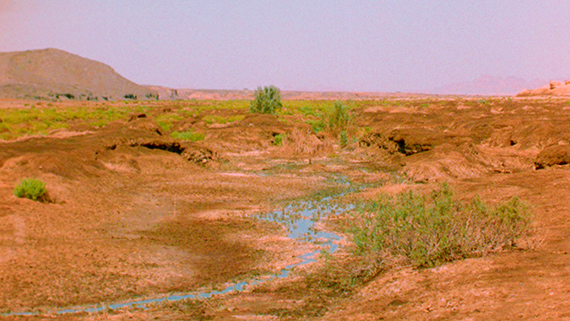
Courtesy of the artist.
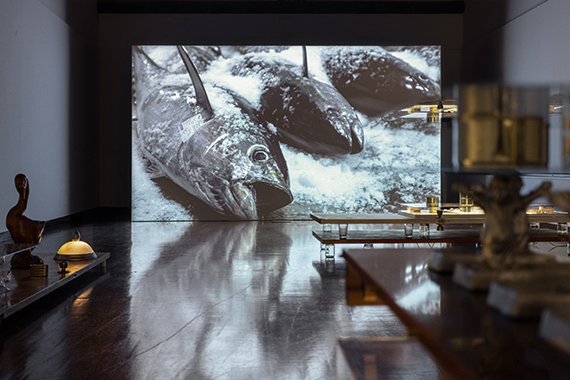
Installation view. © Nadia Belerique. Photo: Mariana Lopes