
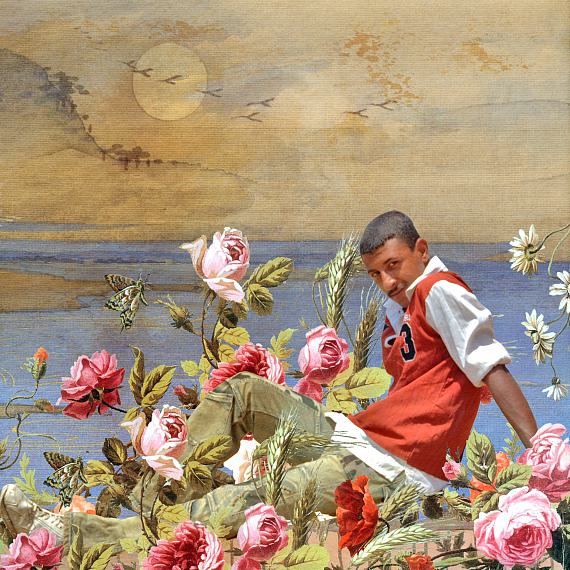
Metaphysics of a Flower I
Archival pigment print on Epson Ultra Smooth Fine Art paper
© Nermine Hammam
Paris Photo 2026 - Group
Main Sector / Booth C18
Ibrahim Ahmed » Bernard Guillot » Nermine Hammam »
Fair: 12 Nov – 15 Nov 2026
Wed 11 Nov
Paris Photo
7 avenue Winston Churchill
75008 Paris
Wed 11-21 (VIP); Thu-Sun 10:30-13 (VIP); Thu-Sat 13-20; Sun 13-19

Tintera
17 Bahgat Aly Street APT 14
Cairo
+201005655005-
zein@tintera.art
www.tintera.art
Sun, Mon, Tue, Thu 11am-5pm, Sat, Wed 11am - 7pm
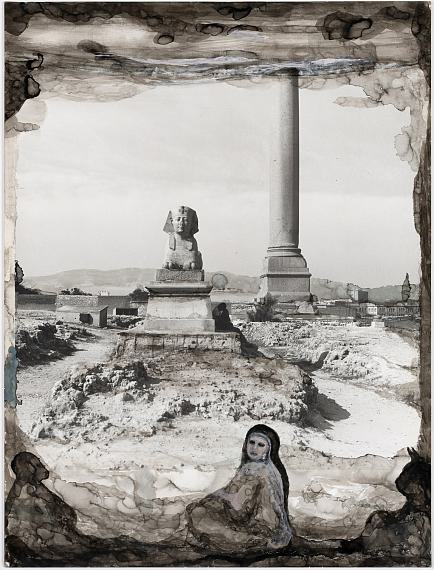
Untitled (The Serapeum), 2017
painted silver gelatin print
© Bernard Guillot
At Paris Photo 2026, TINTERA Gallery (Booth C18) presents works by the late French artist
Bernard Guillot alongside leading Egyptian artists Nermine Hammam and Ibrahim Ahmed,
both making their Paris Photo debut.
Bernard Guillot’s (1950–2021) work is represented by
two deeply personal bodies of work rooted in his
decades-long relationship with Cairo. City of the
Dead / Cité des Morts (1977–2017), created over
forty years, traces his sustained engagement with
Cairo’s historic necropolis, where domestic life unfolds
among tombs and mausoleums. Through long
exposures, dramatic contrasts of light and shadow,
and occasional hand-painted interventions, Guillot
moves between documentary observation and a more
dreamlike, subjective vision. Hotel Maffet Astoria
similarly chronicles a place that became inseparable
from his own life: the downtown pension where he
lived from 1979 until its closure in 2003, as its last
inhabitant. Photographing its rooms, transient guests
and traces of daily life over more than two decades,
Guillot described these works as "a testimony of a
place, of myself, of time." Together, the two series
form an intimate visual archive of a changing Cairo,
shaped as much by memory and personal experience as by the places themselves. Guillot’s
work is held in the collection of the Centre Pompidou, Paris, including a group of his Cairo
photographs from 1977.
Nermine Hammam (b. 1967), is represented by works
from A’aru and Eschaton, two series that draw on
archival and vernacular photography to explore
collective memory, identity and social transformation
in Egypt. In A’aru (2022), named after the ancient
Egyptian concept of the afterlife, Hammam digitally
manipulates, hand-colours and layers black-and-white
vernacular photographs taken on the beaches of
Alexandria, transforming familiar scenes into
dreamlike, totemic images that evoke the archetypal,
the unconscious and the possibility of transformation.
In Eschaton (2009–2013), the beach becomes a stage
on which shifting ideas of identity, masculinity and
self-presentation are played out. The works presented
at Paris Photo depict a range of male figures from
soldiers to sunbathers whose gestures move between performance, vulnerability and self-
conscious display. Through her characteristic layering and intervention, Hammam transforms
these everyday encounters into images in which personal and collective histories, past and
present, continually overlap.
Ibrahim Ahmed (b. 1984), presents works from I never
revealed myself to them (2016–ongoing), an
expansive and evolving body of work through which
the artist examines masculinity, its representations,
and the social structures that shape it. In you can’t
recognise what you don't know (2020), Ahmed cuts,
layers, and reconstructs the male body to question
the performative nature of masculinity. In quickly but
carefully cross to the other side and some parts seem
forgotten, he weaves found photographs from his
father’s family albums together with self-portraits,
creating patchwork-like collages in which personal
histories are fragmented and reassembled. Conceived as an evolving visual diary, I never
revealed myself to them uses the artist’s own body and family archive to navigate inherited ideas of manhood, identity and belonging, while confronting the gaps, absences and
forgotten memories within personal history.
While distinct in approach, the three artists share a commitment to expanding photography beyond its documentary function, using memory, imagination and material intervention to explore how images—and the histories they carry—are preserved, transformed and reimagined.
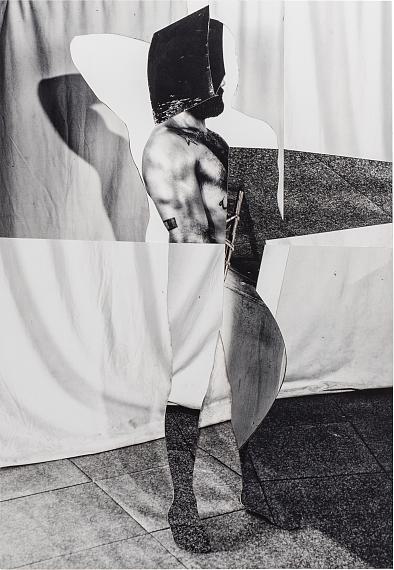
Figure #10, you can't recognise what you don't know, 2020
Unique photocollage
© Ibrahim Ahmed