Deutsche Börse Photography Foundation Prize 2027
Hoda Afshar » Lotus L. Kang » Sasha Kurmaz » Salvatore Vitale »
Exhibition: 10 Mar – 6 Jun 2027

The Photographers' Gallery
16 - 18 Ramillies Street
W1F 7LW London
+44 (0)845-2621618
info@tpg.org.uk
www.thephotographersgallery.org.uk
Tue-Sat 11-19
The four artists shortlisted for the Deutsche Börse Photography Foundation Prize 2027 are: Hoda Afshar, Lotus L. Kang, Sasha Kurmaz and Salvatore Vitale.
The 2027 shortlisted projects feature photography, film and sound, sculptural installations, archival photographs and materials, and handmade collage. The compelling shortlist examines how images shape our understanding of bodies, war, labour and power. Together, the shortlisted artists investigate desire and memory; the human costs of the digital economy; surviving in times of conflict; and the politics of looking. The four artists have made a significant contribution to photography in Europe through projects shown or published within the past 12 months.
The exhibition of the shortlisted projects will be on view at The Photographers’ Gallery, London, from 10 March to 6 June 2027. It will then be presented at the Deutsche Börse Photography Foundation in Eschborn/Frankfurt from 19 June to 26 September 2027.
Jury
The 2027 jury comprises Laia Abril (multidisciplinary artist), Damarice Amao (Associate Curator for Photography at the Musée National d'Art Moderne / Centre Pompidou), Verónica Fieiras (artist, editor and publisher CHACO), Anne-Marie Beckmann (Deutsche Börse Photography Foundation) and Shoair Mavlian (The Photographers' Gallery) as voting chair.
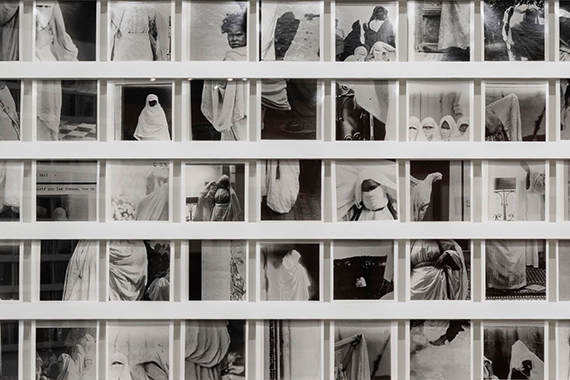
Hoda Afshar (b. 1983, Tehran, Iran) was selected for her exhibition “Performing the Invisible” at the Musée du Quai Branly – Jacques Chirac, Paris, France (30 September 2025 to 25 January 2026).
Through a combination of photographs, drawings, mirrors, videos and sound installations, Afshar explores the history of established perspectives and photography as a tool of revelation and resistance.
“The Fold”, at the centre of the exhibition, examines the enduring legacy of colonial photographic practices and the ways in which they continue to shape how bodies, particularly Muslim bodies, are perceived and consumed. Working with the archive of French psychiatrist and photographer Gaëtan Gatian de Clérambault (1872–1934), Afshar encountered thousands of photographs he made in Morocco. By photographing veiled women, and occasionally men, de Clérambault explored his psychoanalytic theories around veiling and fantasy. Through the recurring motif of the mirror, Afshar disrupts this historical archive and shifts the conventional focus in order to reverse the perspective. The viewer, or the act of looking itself, becomes the object of investigation and knowledge. She questions the violence of the gaze and exposes deeper issues concerning ways of seeing and control.
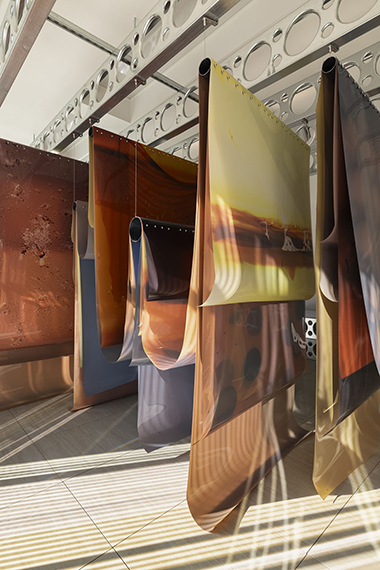
Lotus L. Kang, The face of desire is loss, Bvlgari Pavilion, Giardini della Biennale, Venice, 2026, Courtesy the artist, Bvlgari, Commonwealth and Council, Franz Kaka, Kukje Gallery and Esther Schipper Berlin/Paris/ Seoul, Photo © Andrea Rossetti
Lotus L. Kang
Lotus L. Kang (b. 1985, Toronto, Canada) was selected for the exhibition “The face of desire is loss” at the Bulgari Pavilion, 61st Venice Biennale, Italy (9 May to 22 November 2026).
Combining photography, film and sculpture, this immersive installation reflects on how bodies change over time, what we remember and what is lost. The exhibition’s title references “Thresholes”, a poetry collection by American writer Lara Mimosa Montes. Echoing Montes’ writing, Kang’s installation unfolds in a realm of in-betweenness, where time and the body are fluid and constantly transforming. Lengths of unfixed photographic film, which Kang describes as “skins”, hang from steel supports. Responding to light and humidity, they develop bruises, blood and bile-like hues over time. Sculptures made from tatami mats, as well as cast objects in plaster, bronze and fibreglass depicting crying birds and knots of kelp, evoke the body in states of rest, dreaming, recovery and death. Forty-nine bottles of spirits refer to the number of days a soul spends between death and rebirth in Buddhist belief. They are accompanied by a film of tidal mudflats and visualisations of birdsong, symbolising the constant transformation of life and death.
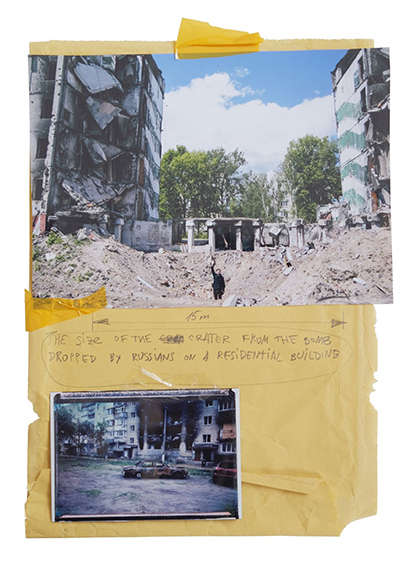
Sasha Kurmaz, From Red Horse. © Sasha Kurmaz 2022–2025
Sasha Kurmaz
Sasha Kurmaz (b. 1986, Kyiv, Ukraine) was selected for the publication “Red Horse”, published by Éditions Images Vevey in November 2025.
Kurmaz began the project following the Russian invasion of Ukraine in February 2022. This diaristic journey into war tells the deeply personal story of his life alongside the lives of those around him who struggle to survive under constant threat. The 800-page visual diary consists of handmade collages that offer a first-hand account of life in Ukraine, a country continually reshaped by the destructive force of war. Kurmaz combines documentary photographs, notes, drawings, newspaper clippings and found objects to capture both his own experiences and those of the people around him. Alongside his thoughts, fears and pain, the accumulation of these fragile collages raises questions about how prolonged states of emergency and war affect individuals, society, democracies and public spaces. “Red Horse” is a powerful reflection on how war transforms our lives and collective memory, and on what it means to create art in times of armed conflict.
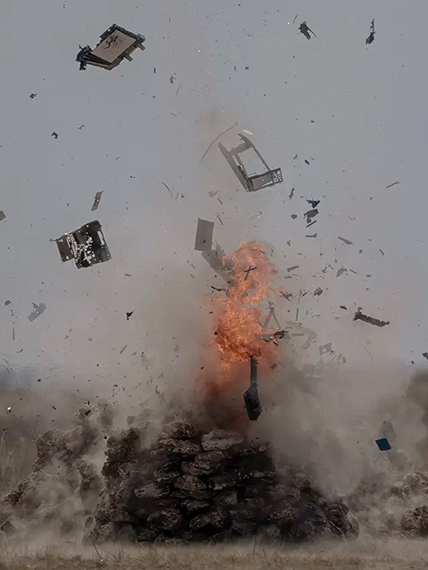
Salvatore Vitale, Untitled, 2025, From the series "Death by GPS", 2022–2026 © Salvatore Vitale
Salvatore Vitale
Salvatore Vitale (b. 1986, Palermo, Italy) was selected for the exhibition SABOTAGE at Photo Elysée, Lausanne, Switzerland (6 March to 31 May 2026).
In “SABOTAGE”, Vitale explores the hidden human labour that sustains the digital economy and questions the systems of automation, surveillance and algorithmic control that increasingly shape contemporary working conditions. The exhibition exposes a central contradiction of technological progress: behind the promise of automation lies a vast workforce whose labour remains largely invisible, precarious and subject to constant monitoring. Developed in collaboration with South African freelancers, “SABOTAGE” examines how contemporary digital infrastructures reproduce historical and colonial patterns of extraction, exploitation and inequality. Through the concept of sabotage, Vitale explores possibilities of resistance, refusal and agency within systems designed to regulate and control human labour. Combining film, photography and sculptural installations, “SABOTAGE” connects the invisible processes of digital labour with their material consequences, revealing a system marked by relentless productivity, exhaustion and wear.
Find more information about the Deutsche Börse Photography Foundation Prize here.
Curated by the Photographers’ Gallery London