
Lotus L. Kang »
The face of desire is loss
Exhibition: 9 May – 22 Nov 2026
In celebration of its role as Exclusive Partner of the 61st Venice Biennale, Bvlgari presents The face of desire is loss, a new commission from artist Lotus L. Kang.
Known for complexly layered environments that meld organic, structural and metabolic languages, Lotus L. Kang’s works give poetic form to reflections on themes spanning inheritance, impermanence, memory, and translation. In The face of desire is loss, the Toronto-born, New York-based artist deepens her engagement with time and the body as uncontainable forms—unruly, sedimentary and nonlinear.
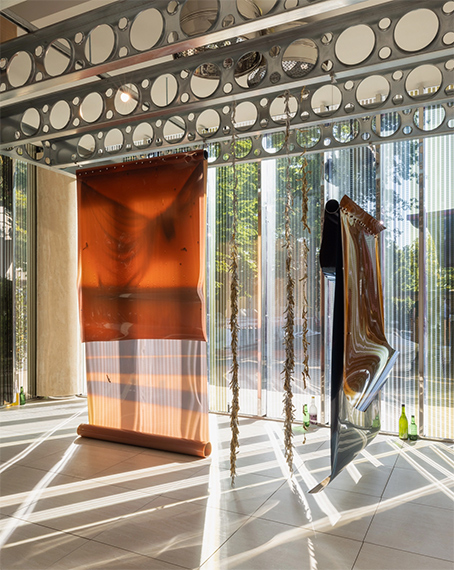
The exhibition draws its title from Lara Mimosa Montes’ Thresholes (2020), a book of poems that gives expansive language to emptiness as form, to holes and voids as generative spaces. Lengths of unfixed photographic film anchor the pavilion, suspended from steel joists whose structure echoes that of the lotus root. Termed ‘skins’ by the artist, the film remains continuously sensitive to its environment for the duration of the Biennale, its palette of bodily hues—bruise, blood and bile—developing in response to the light and humidity of the space over the project’s run.
Above the joists, Kang suspends a suite of sculptures that use tatami mats as their foundation, mattresses that are both vessels and accretive forms, containers for the body in threshold states—resting, dreaming, recovering, expiring—and objects sedimenting traces of the time, spaces and bodies they’ve endured. Inverting up/down, floor/ceiling, under/above, these works elude rootedness and resolution, ever in a state of in-between.
A 35mm film work is installed across the windows of the pavilion, imaged with tidal mudflats—transitional zones where marine and coastal ecosystems meet, merge and overlap—and spectrograms that translate the sounds of crying fledglings and the call of the spoon-billed sandpiper into visual form. Captured in Jeolla, South Korea, the celluloid disperses the film’s duration into a flat, simultaneous plane, as spots choreographed to a score recalling the meter of Kim Hyesoon’s poem Already (2018) cast interstitial light throughout the space.
Around the perimeter of the installation, the artist places 49 bottles of spirits, a nod to the number of days a soul hovers between death and rebirth in Buddhist thought. An open rectilinear structure sits at the rear of the exhibition, coffin-like and full of holes. A fleshy pink silicone lines its base with a single thread strung overhead—a fragile delineation, one that shifts endlessly as air and bodies circulate through the pavilion.