
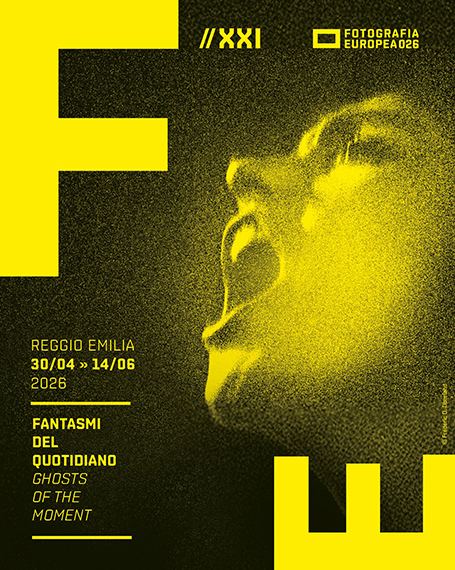
Analog 35mm photograph © Frédéric D. Oberland
FOTOGRAFIA EUROPEA 2026
Fantasmi del quotidiano / Ghosts of the Moment
Elena Bellantoni » Tania Franco Klein » Luigi Ghirri » Simona Ghizzoni » Mohamed Hassan » Ndayé Kouagou » Marine Lanier » Federica Mambrini » Emilia Martin » Frédéric D. Oberland » Ola Rindal » Felipe Romero Beltrán » Giulia Vanelli » Salvatore Vitale » & others
Festival: 30 Apr – 14 Jun 2026
Thu 30 Apr 18:00

European Photography - Reggio Emilia
Corso Garibaldi 31
42121 Reggio Emilia
+39.0522-456249
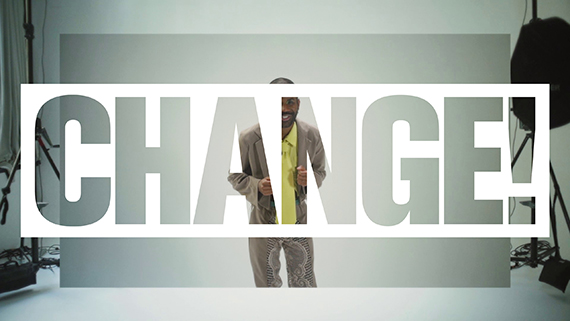
A coin is a coin 2022
one channel video
Ndayé Kouagou ‘Heaven’s Truth’ | Collezione Maramotti, Italy
From 30 April to 14 June 2026, Reggio Emilia will once again look at contemporary changes through the eyes of leading photographers and emerging talents with the 21st edition of FOTOGRAFIA EUROPEA, the festival promoted and organised by Fondazione Palazzo Magnani and the Municipality of Reggio Emilia, with the support of the Emilia-Romagna Region.
“GHOSTS OF THE MOMENT” is the theme chosen by the Festival curators: Arianna Catania (founder and director of Gibellina Photoroad / Open Air & Site-specific Festival), Tim Clark (editor and curator at 1000 Words) and Luce Lebart (researcher at the Archive of Modern Conflict and artistic director of the Pavillon Populaire in Montpellier). In addition, there is a historical overview by Walter Guadagnini (photography historian and teacher at the Academy of Fine Arts in Bologna) dedicated to 200 years of photography.
The “ghosts” we will meet and take on are the shadows of something that has lost its body, yet keeps knocking at the night of the mind. These ghosts are not just apparitions, but memories that refuse to be consigned to the past, fears dressed as mystery and presences made entirely of absence. They dwell in the corridors of silence, live in the cracks of memory and feed on what was left unsaid. When they manifest, at times they make us tremble; at others they shield us into forgetting. They have no face, only a thousand masks. You can drive them off with the light of an idea, or listen to them to learn what they hunger for. Yet ghosts are not only a menace, they are latent presences, suspended potentials, ideas that never quite departed. This edition of Fotografia Europea is an invitation to seek out the unseen and the invisible, paying attention to the whispers of what has been and what could be. The featured artists reveal the silent stories that inform and guide our present while simultaneously opening up new paths for the imagination. The Festival explores the quiet endurance of memory – how memories fade and yet refuse to vanish entirely. Each photograph holds its own echo, a spectral reminder that even as time slips away, it keeps its essence suspended. In these exhibitions, the past is not gone, it breathes softly within the now.
For two centuries, photography has captured shadows, preserved faces and constructed collective memories, moving among these ghosts. The second part of this journey will delve into its history, examining how images have accompanied, interpreted and sometimes reinvented the lives of men and women from the 19th century to the present day.
It is here that our dialogue with the “ghosts” takes shape, traversing archives, authors and technologies that have shaped the way we see, perceive and understand the world around us.
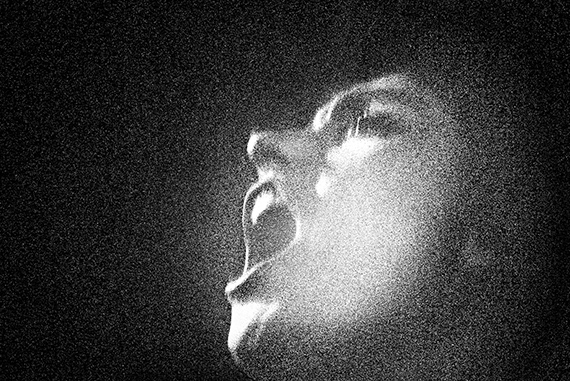
Analog 35mm photograph © Frédéric D. Oberland
EXHIBITIONS
CHIOSTRI DI SAN PIETRO
via Emilia San Pietro, 44/c
Felipe Romero Beltrán » Bravo
Curated by Tim Clark
Bravo situates itself in the liminal space of the Río Bravo, a territory marked by migration where geography and identity collide. Focusing on a 270-kilometre stretch of the river, Romero Beltrán constructs an elusive visual narrative in which the river becomes a silent protagonist, shaping lives while remaining largely absent from view.
Through portraits, interiors, and landscapes, Bravo captures the suspended time of migration. Romero Beltrán’s precise visual language articulates a political reality in which meticulously staged portraiture both reveals and conceals resilience. Everyday objects within the interiors, a speaker, a mattress, a red-painted table, acquire symbolic weight, reflecting conditions of precarity and control.
Structured in three chapters, Endings, Bodies, and Breaches, the project challenges systems of classification, enclosure, and identification that govern border regimes. The audiovisual work El Cruce further emphasizes the river’s dual role as both life source and militarized boundary, intertwining scenes of baptism, fishing, and migrant testimony. With accompanying texts and an interview with the artist, Bravo emerges as a poetic yet urgent meditation on a border defined by contradiction, where hope and despair, movement and stasis coexist.
This project won the KBr Photo Award 2025, a biennial award organized by the Mapfre Foundation that includes the creation of an exhibition and a book.
Mohamed Hassan » Our Hidden Room
“This is about my father. This is about me. This is about our hidden room.”
Our Hidden Room is a photographic and narrative project that tells the fragmented story of a complex yet deeply loving relationship between the artist and his father, who was also a photographer. Blending photography and storytelling, the work unfolds as a raw and intimate exploration of family, memory, and loss.
During the artist’s childhood in Egypt, his father often behaved erratically and withdrew from the world, becoming increasingly obsessed with a small, dark hidden room within the family home. This space both physical and psychological became a site of solitude, fixation, and unspoken struggle. Living with bipolar disorder at a time when mental illness was poorly understood and heavily stigmatised, the father’s condition went largely unacknowledged, ultimately leading to his suicide.
Across six chapters, the project traces the father’s life from a difficult childhood in an orphanage in Alexandria to his service in the Egyptian Army, where he discovered photography as both an artistic practice and a form of refuge. Through a deeply personal lens, the artist reflects on resilience, inherited trauma, and the silence surrounding mental illness. Photography, once a source of pain and conflict within the family, becomes a means of reckoning and healing for the artist transforming loss into meaning and preserving memory as an act of love. Our Hidden Room stands as a testament to the power of art to bear witness, to hold tenderness and pain in the same frame, and to find beauty even in absence.
Salvatore Vitale » Automated Refusal
Written and directed by: Salvatore Vitale
Single-channel video installation with environment
Colour, sound 24’36” English
Automated Refusal is part of Death by GPS, an examination of how automation technologies are reshaping labour and revealing the contradictions of digital capitalism.
In Automated Refusal, Salvatore Vitale explores the fragile realities of gig work, where surveillance, rankings, and long hours blur the boundaries between life and labour. The film questions how technology reshapes the relationship between people and their environments in the digital age.
Blending observation and fiction, the work examines how automation transforms not only work but also identity and social connection. Through fragmented storytelling and interrupted rhythms, it mirrors the instability of digital labour and the uncertainty of those who depend on it.
The video follows four freelancers navigating the precarious tech economy. Their stories unfold in parallel, each revealing personal strategies of refusal and quiet resistance. Rather than showing open rebellion, the film focuses on small acts of defiance, such as moments of hesitation, retreat, or persistence that reveal traces of agency within systems of control.
Grounded in research, interviews, and situational testimonies, Automated Refusal reimagines these experiences through scenes that combine elements of reality and fiction. The result is a portrait of contemporary labour marked by contradiction and endurance.
Vitale explores the tension between automation, exploitation, and the search for autonomy, reminding us that even in technological systems, human presence remains essential.
Marine Lanier » Le Jardin d’Hannibal (Hannibal’s Garden)
Curated by Luce Lebart
Le Jardin d’Hannibal is set in the Lautaret Garden, the highest alpine botanical garden in Europe, located at 2,100 meters beneath the Meije glaciers. Home to more than 2,000 plant species, it functions as a conservatory of alpine flora from the world’s great mountain ranges. Since spring 2019, I have spent extended periods living in the Mirande laboratory chalet with ecologists, botanists and gardeners. As the snow melted, alpine plants from across the globe gradually reappeared among meadows and rocks.In the evenings, shared stories included the legend of Hannibal, said to have crossed the Lautaret Pass with a heterogeneous army during his Alpine campaign. These ancient visions merge with the images I make in the garden, forming a dreamlike and nocturnal herbarium where plants emerge from winter like the traces of an impossible journey. This garden laboratory echoes resistance, much like Hannibal opposing Rome, standing today against climate change. For over two centuries, scientists have studied biodiversity here, sustaining a global network of seed exchange that preserves living memory. Today, the garden is a center for research on global change. One experiment relocates alpine turf by helicopter to lower altitudes to study the effects of rising temperatures. Through large format photography and colored monochromes inspired by Karl Blossfeldt, Anna Atkins and early landscape photography, I explore fragments of life and imagine a primitive world in transformation.
Ola Rindal » Stains and Ashes
“If I walk in the street, I see houses, cars, trees, people. But in between there are stains, cracks, holes. Sometimes they are like sculptures, sometimes like doors, openings, and sometimes like drawings or paintings. It can be a puddle of water or an oil stain from a car, a crack in the wall, a piece of garbage… these stains have no meaning, no language or narrative. Yet they exist in between all the other elements around us”.
The project began with a spot on a cloth; an observation. The artist photographed the spot. Then, he created new spots with ink on paper. Furthermore, he developed the theme with both photos and drawings. After a while, he started incorporating blurred, sometimes nearly abstract portraits.
Blurring and abstraction are inherent in the nature of photography, just as it is capable of capturing a sharp image. A blurry image has often been seen as a failure, but Rindal uses this characteristic to express distance, a sense of not getting closer, not understanding. As if reality is escaping. The blurriness settles like a movement, a fog, a disturbance, an unrest, and withholds information about what we see, appearing like memories or subconsciousness.
Tania Franco Klein » Subject Studies
Subject Studies is an anthropological project. This series investigates how identity and bias shape perception. Klein photographed 106 subjects of varying ages and ethnicities in identical settings, including a diner, bathroom, car, and living room, with consistent lighting, composition, and poses. Only the human subjects change from one image to the next. This interactive anthropological project challenges viewers to confront their assumptions, asking: Why do we have different emotional responses to each image when the context remains the same?
Giulia Vanelli » The Season
The past can be seen not as a dimension that has concluded but as an active presence that continues to resurface in the present, influencing the way we inhabit time and construct our identity. Some experiences, especially those lived during childhood and youth, do not dissolve as the years pass, but remain suspended, deposited like sediment in the places and gestures we go back through. The Season is born from that persistence.
Set in a small seaside village in Tuscany, the project offers an emotional journey through memories intertwined with the photographer’s summers. The place, enriched by the ancestral magic it has cleverly guarded over the years, is capable of flattening rhythms and lengthening months, creating a cycle of time that seems to resist the changes taking place in the outside world. In this context slowness becomes a central element and invites us to reflect on the relationship between time and memory, as well as on the nuances of a relationship that can, depending on the circumstances, be both reassuring and claustrophobic.
Simona Ghizzoni » Milk Wood
We are not wholly bad or good / Who live our lives under Milk Wood, / And Thou, I know, wilt be the first / To see our best side, not our worst (1)
“I too had forgotten the old station, even though it was from there that I left for the first time, as a young adult, many years ago. While I was trying to figure out how to describe a place I had forgotten, an old edition of Under Milk Wood, translated by Carlo Izzo, caught my eye on the bookshelf”.
Under Milk Wood is Dylan Thomas’s last work, published posthumously, a radio play that recounts the dreams, hopes and nightmares of a small, colourful community at nightfall. Thomas invites us not to be afraid and to enter the inhabitants’ rooms as if the walls had become transparent during sleep. It is an invitation to consider listening, or in our case looking, as an ontological act, as an affirmation and recognition of the existence of others and, consequently, of our own.
The gaze has two directions; as we move away, what we are looking at also moves away, when we walk quickly, careful not to meet the eyes of others.
Simona Ghizzoni began early in the morning, listening to and collecting the words of a group of women who meet on Wednesdays in Via Turri, at Binario 49. Other women joined the initial group, women who live in the neighbourhood, others who work there, others who are volunteers or who come here to meet up.
The work, which moves between photography, pictorial processing and audio, is therefore a proposal for a lexical and visual reinterpretation of the station neighbourhood, starting precisely from these weekly dialogues. The images on display will be largely the result of collaboration with the participants, who are in fact co-authors of the works.
(1) Eli Jenkins’s prayer, Under Milk Wood, Dylan Thomas
Frédéric D. Oberland » Vestiges of the Future
Frédéric D. Oberland’s works unfold a multisensory practice where experimental photography, film and music continually feed one another. He visually works with grainy photographs, poetic observational gestures and Super8 film, exploring fragile temporalities, flickers and overexposures that resonate with the impermanence of sound. Psychedelic colour-grading directly on the negative produces kaleidoscopic images where bodies, landscapes and rituals dissolve into ephemeral, chromatic traces. As a composer, his music emerges from altered states of consciousness suspended between reminiscence and imagination, using long forms that stretch, accumulate and break open, echoing both geological processes and collective urgencies.
With Vestiges of the Future, Frédéric D. Oberland exhibits a site-specific installation expanding his eponymous photobook published by Sun/Sun editions. It captures the sensation of a close call; the flash where life appears all at once, as a flood of hallucinated visions in a trembling world, a quantum space and time inhabited by ghosts, traces of what has just been or what is about to vanish or appear.
Keep the Fire Burning
Photobook exhibition curated by Francesco Colombelli,in collaboration with Centro diurno per l’adolescenza “AÏDA”
Hoda Afshar » Christopher Anderson » Atong Atem » Chen Chuanduan » Theo Cottle » Heinz Daniels » Cristina De Middel » Sanne De Wilde » Chloe Dewe Mathews » Antone Dolezal » Eikoh Hosoe » Rinko Kawauchi » Bénédicte Kurzen » Bruno Morais » Tito Mouraz » Emilio Nasser » Regine Petersen » Stephanie Roland » Alessia Rollo » Marialba Russo » Ioanna Sakellaraki » Lara Shipley » Homer Sykes » Alys Tomlinson » Rebecca Topakian » Patrick Willocq » Zhang Xiao » Xu Xiaoxiao » Yelena Yemchuk » Vasantha Yogananthan » ...
This selection of photobooks explores how myths, fairy tales, stories of witchcraft and spirituality, popular beliefs, religious traditions and traditional clothing continue to inhabit our present. The ghosts evoked are not only supernatural presences, but also cultural traces, collective memories, customs and archaic imagery that persist – often in latent form – in everyday life.
The selected photobooks recount what has been handed down from generation to generation, mainly through words, example and repetition. This fragile knowledge, entrusted to memory and the body rather than written texts, resists the passage of time but is slowly at risk of disappearing.
Although they belong to different geographical and cultural contexts, these practices share the same function: to create bonds, explain the unknown, protect and remember. This varied selection aims to bring these differences and affinities into dialogue, constructing an emotional and cultural geography that crosses borders and generations. An intimate and temporal object, the photobook becomes an ideal container for these “ghosts”, allowing them to be handled, opened, shared and disseminated, keeping alive the traces of an intangible heritage that continues to speak to us, if we still know how to listen.
PALAZZO DA MOSTO via Mari, 7
Ghostland
Curated by Arianna Catania
Indrė Šerpytytė » Zoé Aubry » Sara Bezovšek » Carolyn Drake » Alisa Martynova » Visvaldas Morkevicius » Mykola Ridnyi » Vaste Programme »
The projects by Indrė Šerpytytė and Visvaldas Morkevičius are part of the Cultura Lituana in Italia 2025–2026 programme, created by the Institute for Lithuanian Culture and the Embassy of the Republic of Lithuania to the Italian Republic.
In our hyper-mediated age, reality increasingly appears as a “spectral” territory; a landscape in which experiences, bodies and events are filtered, translated and recoded through luminous surfaces, screens.
Ghostland explores this intermediate space in which we live – a space where the screen is no longer just a technical device, but a real cultural environment, capable of shaping our perceptions and behaviours, designing collective imaginaries.
The visual technologies that inhabit our daily lives – surveillance systems, social interfaces, digital archives, artificial intelligence and information flows from conflict zones – construct a complex emotional geography, made up of apparent proximities and profound distances. Here, the face becomes a mirror, the body a manipulable surface, memory an archive in constant rewriting, functional to imagining a dystopian future. War, disasters, the alteration of the self and a widespread sense of vulnerability require mediation with the aim of alleviating pain and multiplying spectacle in the face of a world that is sometimes incomprehensible and difficult to decode.
Ghostland offers a reflection on how we observe others and ourselves, how algorithms monitor us, how we construct a sense of danger and trust in a future yet to be built. Through experimental artistic practices, the collective exhibition invites us to recognise the contemporary condition of constant oscillation between presence and absence, between materiality and simulacrum, which characterises our present and our near future. Finally, it is an invitation to reflect not only on what we see but above all on what remains outside the field of vision: the blind spots, the omissions, the spaces where reality continues to elude us or reveals itself only through the frame of the screen.
Emilia Martin » The Serpent’s Thread
Open Call 2026As a child, Emilia Martin spent countless hours observing her beloved grandmother, a Polish countryside textile worker, stitching scraps of material into objects that were new, soft and enduring. Like a storyteller weaving elements into a tale, her textiles were composed of many fibres, many threads and many hands reaching back through time. Textile-making became her language, carrying the knowledge of generations of women. When Martin’s grandmother passed away, her works, perceived as having no value, were discarded or lost. Inspired by this missing archive of a life’s work, Martin began tracing other histories of women whose textiles serve as ghosts where records fall silent, continuing an intergenerational legacy of weaving scraps into stories.
The Serpent’s Thread follows fragmented records and folklore surrounding the five Andersson sisters, who lived in the small Swedish village of Åsmundtorp at the turn of the 20th century. Their history, partly documented and partly mythologised, revolves around the textiles they produced as elaborate dowries – objects meant to demonstrate a woman’s skill, diligence and moral worth, and to represent her value as a potential future wife.
Federica Mambrini » L’albergo della lontananza
Open Call 2026How can two people be together if they live in two different hemispheres of the world? Is it possible to build a bridge between two places? The project unfolds between Italy and Chile and is based on specific architectural situations that have been studied or created.
The generator and catalyst of the project is a long-distance relationship between two people, divided between two distant continents, who try to draw closer by analysing the space that separates them.
Five situations are analysed: the bridge, two squares, the room/the doubt, the kiss and the desert.
PALAZZO SCARUFFI
via Crispi, 3
200x200.
Due secoli di fotografia e società (Two Hundred Years of Photography and Society)
Berenice Abbott » Robert Capa » Henri Cartier-Bresson » Louis Jacques Mandé Daguerre » Walker Evans » Fratelli Alinari » Dorothea Lange » Man Ray » Eadweard J. Muybridge » ...
The exhibition aims to be both a tribute to the history of photography and an opportunity to reflect on the presence of its language in society from the mid-19th century to the present day, starting with the historic image produced by Joseph Nicéphore Niépce in 1826 that is considered the earliest surviving example of a photograph.
The exhibition does not claim to offer an impossible history of photography in bite-sized pieces, nor to be a precious collection of masterpieces, but instead intends to shed light on the importance of photography in defining society and the collective imagination of the last two centuries, as well as the mechanisms of its dissemination around the world.
Curated by Walter Guadagnini – photographic historian, teacher at the Academy of Fine Arts in Bologna and long-standing artistic director of the Fotografia Europea festival – the exhibition has been constructed through photography from public and private collections in Italy. It also exhibits images reproduced in newspapers, magazines and posters, through displays of books and films, as well as devices that span from the earliest cameras to modern-day smartphones. Finally, the exhibition also includes a number of photographs from the “public domain”, precisely to highlight photography’s extraordinary capacity to be a reproducible language, which, thanks to this characteristic, became the most important language of the 20th century and, still today, plays a central role in the world of communications and figurative arts.
Not necessarily masterpieces taken by great photographers – even if many are included in the show, from Louis Daguerre to the Fratelli Alinari, from Julia Margaret Cameron to Eadweard Muybridge, from Man Ray to Henri Cartier-Bresson, Robert Capa, Dorothea Lange, and leading figures in contemporary photography around the world – but images that have had, and still have, a particular significance to the history of humanity over the last two centuries, for different reasons.
As well as showcasing the unusual spaces of Palazzo Scaruffi, the staging will respond to the evolution of photographic language, taking the viewer back to specific moments that have marked the history of photography and the world, in a continuous and fascinating journey to discover photography’s endless different characteristics.
CHIESA DEI SANTI CARLO E AGATA
via San Carlo, 1
Elena Bellantoni » Ghostwriter
Curated by Fulvio Chimento
In collaboration with the Equal Opportunities Office of Reggio Emilia City Council as part of the project In-tersezione. Focusing on languages and practices to promote change in the fight against violence against women
Ghostwriter refers to a ghost from history, a sort of “re-evocation” of events expressed through symbolic figures of the human experience. This re-evocation is activated through the artist’s body, which invites us to reflect on the ways through which history can be recounted, remembering that “women are the unexpected bodies of history”, as maintained by Carla Lonzi.
Through the language of photography and auteur cinema, with incursions into sculpture and installation, the exhibition designed by Elena Bellantoni draws on the theme of the uncanny; it explores things that upset or alter social, physical or psychic nature, which disturb the human mind and soul, forces that are activated by leveraging ordinary fears, capable of creating conditioning, or even a “collective egregore”. It is as if history were being rewritten cyclically by the same hand, a hand that stays mysteriously in shadow, generating events that are an expression of perpetually opposing forces and infinitely replicable outcomes. Umberto Eco himself referred to “The eternal dimension of fascism” in his essay Eternal Fascism, not with reference to a specific historical regime, but to an archetype of thought and behaviour (Ur-Fascism), which is manifested today in camouflaged forms (in civilian clothes) through elements such as irrationalism, the rejection of criticism, the fear of diversity, machismo and populism.
Partner Exhibitions
PALAZZO DEI MUSEI
via Spallanzani, 1
Luigi Ghirri » A series of dreams
Paesaggi visivi e paesaggi sonoriOltre quei monti il mare - Iosonouncane
Curated by Ilaria Campioli and Andrea Tinterri
The reinstallation of the photography section at Palazzo dei Musei in Reggio Emilia for 2026–2027 explores what Luigi Ghirri called the “strange and mysterious kinship between sound and image”, a relationship that had always fascinated him. A passionate music lover, Ghirri assigned music a central role in his life and work; this is evident in his devotion to Bob Dylan, his deep friendship with Lucio Dalla and his significant record collection. It also emerges in his writings, which are interwoven with references to the influence of music on the way he saw and the way he constructed images. Like painting, philosophy, literature, photography and cinema, music contributed to shaping that “image of the outside” on which Ghirri constantly reflected, recognising in it – much like in photography – a narrative power capable of opening up true “visionary ruptures”.
An entire nucleus is conceived as a space for experimentation and reflection around the theme of the soundscape, thanks to the participation of musician Iosonouncane. Creating a dialogue between Ghirri’s “ecology of vision” and R. Murray Schafer’s “acoustic ecology”, the intervention seeks to convey the depth of a line of thought which – though developed in different contexts, yet in the same years – points to an increasing difficulty in seeing and hearing; a saturation that affects the environment, the outside world and our relationship with nature. From this perspective, the sonic landscape and the visual landscape correspond as two modes of orientation, two forms of relationship with the environment and what surrounds us.
A focus devoted to images created for RCA classical music covers is installed in the octagonal hall of Teatro Valli. This choice recalls a place that was central to Luigi Ghirri’s experience; he collaborated for many years with I Teatri di Reggio Emilia, photographing performances and spaces. Alongside the covers, the exhibition will present valuable images held in the Teatro Municipale Historical Archive – photographs of productions from those years that reflect how Ghirri saw both the stage and theatrical time.
Giovane Fotografia Italiana #13 |
Luigi Ghirri Award 2026
Susanna De Vido » Karim El Maktafi » Alice Jankovic » Cinzia Laliscia »
Anie Maki » Eva Rivas Bao » Federica Torrenti »
Curated by Ilaria Campioli and Daniele De Luigi.
GFI #13 | Luigi Ghirri Award 2026 is made possible thanks to European funds from the Emilia-Romagna Region.
Promoted by the Municipality of Reggio Emilia in partnership with the Luigi Ghirri Foundation and the IIC in Stockholm.
In collaboration with Associazione GAI, Fotografia Europea, Fotodok Utrecht; Fotofestiwal Łódz; Photoworks Brighton.
With the contribution of Reire srl and Gruppo Giovani Imprenditori Confindustria Reggio Emilia.
The international jury selected seven artists: Susanna De Vido, with Quando torneremo a guardare le stelle (When We Return to Look at the Stars, Karim El Maktafi, with Archivio del mare (Archive of the Sea), Alice Jankovic, with Green Paradox, Cinzia Laliscia with Finalmente posso andare (Finally I Can Go), Anie Maki, with Milk, Weight, Gravity, Eva Rivas Bao, with Una storia italiana (An Italian Story) and Federica Torrenti, with La fortezza (The Fortress).
The selected projects addressed this edition’s theme, Voices; photography confronts that which escapes the gaze, existing in a constant state of suspension between appearance and disappearance, documentation and evocation. In an age dominated by an excess of images, many lives remain unrepresented. The exhibition offers a space for reflection and imagination, questioning the ability of images to give voice to the missing and opening up new ways of seeing and existing.
The finalists will also compete for the Premio Luigi Ghirri, worth €4,000, as well as other important recognitions such as the Nuove Traiettorie. GFI a Stoccolma mention, which offers one of the selected artists the chance to spend time studying and researching, during which they will be asked to develop an artistic project to be put on display in an exhibition curated by the IIC in Stockholm. Finally, one of the finalists will have the opportunity to take part in the Photo-Match portfolio review programme at Fotofestiwal Łódź.
SPAZIO GERRA
Piazza XXV Aprile, 2
Francesco Guccini. Canterò soltanto il tempo
Kai-Uwe Schulte-Bunert » Paolo Simonazzi » ...
The exhibition offers an intimate, although not private, glimpse in which Guccini’s voice takes the visitor metaphorically by the hand and accompanies them through the rooms. It is a game that foregrounds his words, songs and voice, with its unmistakable grain.Various materials have been made available by the author, many of which have never been displayed before, helping create a constructed narrative, almost like a concept album, around memory, remembrance and time, understood as the flow of life. A series of photographs from Guccini’s personal collection retrace some of the salient moments of his life and career. Each exhibition section has also been interpreted visually by artists, photographers and illustrators invited to provide their contribution.
In this context, two new photographic productions on display have been inspired by Guccini’s favourite themes and those he himself describes as “faded visions of ghosts and people”. With Pavana e ricordi, Paolo Simonazzi goes in search of glimpses of Guccini’s sentimental geography.
While Kai-Uwe Schulte-Bunert tries to give shape, however abstract, to time. Dismantling its mechanisms both metaphorically and physically, he presents it to us as a continuous fluctuation in an undefined space that the camera lens is capable of capturing only in a fragmentary and random way.
Further illustrations on display are the work of Simona Costanzo, Arianna Lerussi, Veronica Ruffato, Silvano Scolari and Gianmario Taurisano.
COLLEZIONE MARAMOTTI
via Fratelli Cervi, 66
Ndayé Kouagou » Heaven’s truth
This is the first solo show in Italy by Parisian artist Ndayé Kouagou. It brings together recent works and others made specifically for the exhibition, including a new project inspired by the narrative device of photo comics.
Kouagou’s creative practice, which moves between visual art and performance and is often inhabited by the artist’s alter ego, hinges on language. The texts that he authors – which seem familiar, muddled and tongue-in-cheek, all at once – are the catalyst at the core of videos, installations and live exhibitions that gradually yet forcefully reveal the instability of language, the opacity of words, and the shifts in meaning that are intrinsic to communication in the media and among individuals.
Through dialogues, monologues, questions and statements that avoid any clear definition of their own subject, Kouagou touches deep chords in the conscious and unconscious mind, exploring individual and collective choices and attitudes toward the world.
In a disorienting narrative experience that is both playful and existential, the artist leads visitors through a journey with no destination, where the landmarks seem hazy or even completely illogical.
His works prompt a meditation on truth (real, potential or imaginary), vulnerability, unease and power dynamics, probing the intricate contradictions of our subjective reality and the paradoxes of today’s world.
EVENTS
As it does every year, the Festival also draws on a calendar packed with events for visitors spanning from the opening days – 30 April to 3 May: lectures, meetings with the artists, book presentations and signings, portfolio reviews, workshops, a book fair dedicated to independent publishers, and shows. These events have all been designed to fuel cultural debate; taking photography as its starting point, they tackle more general themes, involving an increasingly large and diverse public, aware that Reggio Emilia offers the best that contemporary photography produces and offers.
TALKS AND PERFORMANCES
The programme for the opening days and all subsequent events is now online
learn more
[PARENTESI] BOOK FAIR
Book fair dedicated to photo publishing, book presentations and book signings
learn more
PHOTOLUNCH
Have lunch with an artist to enjoy conversation, inspiration and networking!
learn more
PORTFOLIO REVIEW
Meet curators, photo editors and photography experts on 2 and 3 May, registrations now open!
learn more
TICKETS
Get the early bird ticket for €17! Until 23 April at 11.59 pm
Learn more
The CIRCUITO OFF – the collective and independent event that supplements the festival with an endless series of exhibitions spread around the city – presents professional photography projects alongside young, novice photographers, enthusiasts and associations. Their photographs will be displayed in shops, restaurants, studios, private courtyards and homes, historical venues and art galleries. The OFF@school project, which involves schools across the province of Reggio Emilia, is also part of this circuit.
Further info available from www.fotografiaeuropea.it